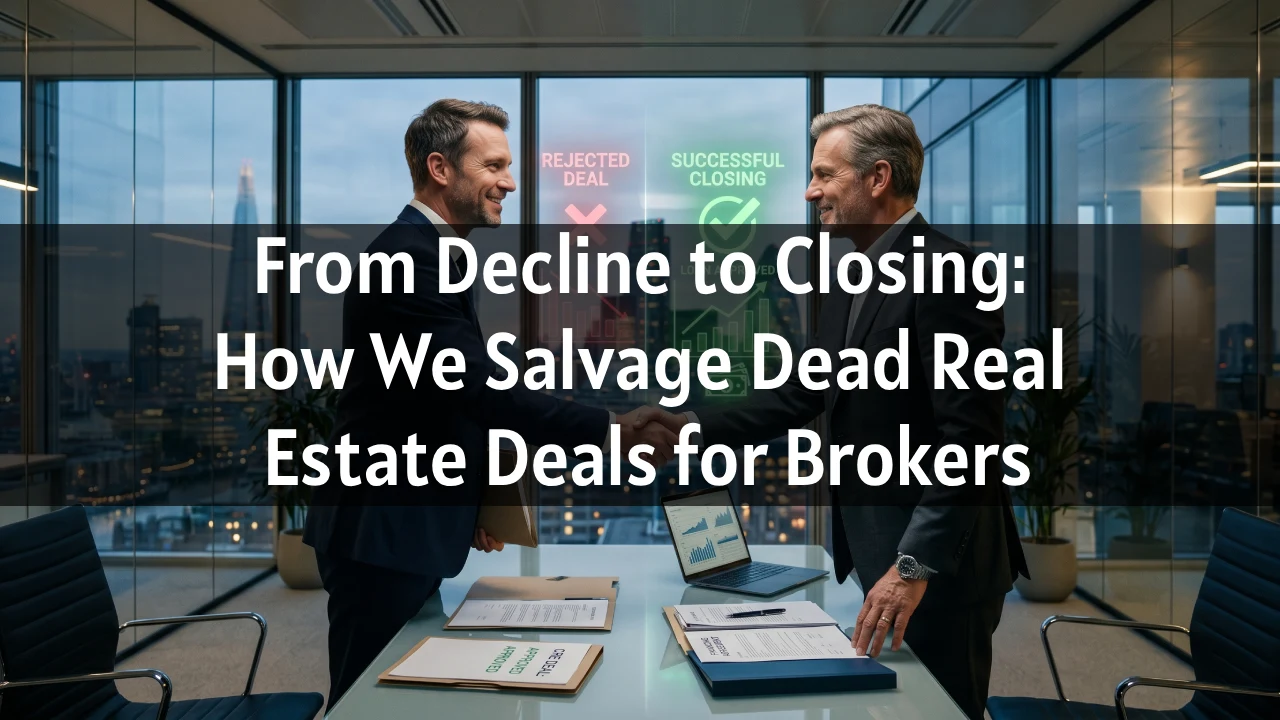
From Decline to Closing: How We Salvage Dead Real Estate Deals for Brokers
A "No" from a traditional bank in 2026 is often a reflection of their rigid regulatory "box," not the quality of your deal. Commercial Lending USA specializes in salvage dead real estate deals by leveraging 30 years of underwriting experience and serving as a correspondent and table lender. We transition "dead" files into closed deals using over 75 flexible loan products, including DSCR, Bridge, and No-Doc options.
How to Salvage Dead Real Estate Deals
To salvage dead real estate deals, a broker must move the file from a rigid traditional lender to a flexible correspondent or table lender. The process involves three tactical shifts:
- Re-Underwriting: Identifying the "technicality" that triggered the decline (often debt coverage or credit overlays).
- Capital Migration: Moving the deal to private equity or debt funds that prioritize Asset Value and LTC (Loan-to-Cost) over personal tax returns.
- Bridge Structuring: Using short-term capital to stabilize the property before moving into long-term Fannie Mac or Freddie Mac "takeout" financing.
The 2026 Market Context: The "Maturity Wall" Crisis
As we navigate 2026, the commercial real estate sector is hitting a massive "Maturity Wall." Billions in debt are coming due at rates significantly higher than their original terms.
Traditional banks have tightened their belts, focusing only on "perfect" "A-class" properties. This leaves a massive gap for:
- Multifamily properties need modest stabilization.
- Self-storage and Assisted Living facilities that are performing well but don't fit the new bank's "risk profiles."
- Fix-and-Flip investors who need speed over low-interest rates.
For a broker, a "Decline" today isn't a sign of a bad investment; it’s a sign of a misaligned lender. We act as the bridge between that "No" and the closing table, ensuring your commission stays in your pocket and your client stays in the game.
The 2026 Credit Crunch: Why "Good" Loans Die
In today's market, a deal doesn’t die because it lacks value; it dies because it lacks a home. Traditional banks have moved toward "defensive lending," meaning they are more focused on avoiding risk than capturing opportunity. If your file doesn't fit a 2026 "perfect profile," it’s headed for the shredder.
For brokers, this is more than a lost commission. It is a blow to your reputation. When you can't deliver a closing, you risk losing that client to a competitor who can.
The 4 Primary "Deal Killers" in the Current Market
To salvage a deal, we must first diagnose the cause of death. We typically see four hurdles that stop traditional lenders cold:
1. The "Regulatory Box" (The DSCR Trap)
Most banks use rigid Debt Service Coverage Ratio (DSCR) requirements. If a multifamily or office property has a temporary vacancy or rising insurance premiums, the bank flags it as a "fail." They don't look at the projected income; they only look at the historical "pain."
2. The Documentation Wall
Standard lenders are obsessed with global cash flow and two years of perfect tax returns. For self-employed investors or those with complex portfolios, this is a non-starter. We see "Dead Deals" every day where the asset is a goldmine, but the borrower’s tax paper-trail is too "noisy" for a local bank.
3. Asset Class "Blacklisting."
In 2026, many institutions have simply stopped lending in specific sectors. Whether it is Senior Housing, Assisted Living, or Unimproved Land, a "No" often has nothing to do with your client’s credit the bank has just closed that department.
4. The "Speed to Close" Gap
A "Fix-and-Flip" or a "Bridge" opportunity waits for no one. While a bank spends 90 days in a committee, the seller moves on to a cash buyer. A deal that takes too long is, for all intents and purposes, a dead deal.
2026 Statistical Insight
Market Data Point: Recent 2026 lending surveys indicate that commercial loan abandonment rates have increased by 22% year over year. However, private credit and "Table Lenders" have filled nearly $45 billion of that funding gap. This proves the capital is available it has just changed its address.
The High Cost of Walking Away
When a broker accepts a bank's decline as the final word, they leave money on the table.
- Lost Revenue: The average commercial commission lost on a "Dead Deal" is $15,000-$50,000.
- Damaged Authority: Clients want a "Certainty of Execution."
- Wasted Labor: The hours spent collecting documents and submitting them to banks become a total loss.
The Solution? We don't see a decline as a dead end; we see it as a referral opportunity.
The 3-Step Salvage Engine: How We Resurrect Your Deals
At Commercial Lending USA, we don't just "re-submit" your file to another bank. We use a proprietary underwriting approach to restructure the deal from the ground up.
1. The 30-Year Underwriting Audit (Deep-Dive Analysis)
Traditional lenders often use automated software that flags "red flags" without context. Our team manually reviews the file, drawing on three decades of underwriting abilities.
- The Goal: To find the "Compensating Factors."
- The Action: If a bank declined a loan due to a low DSCR, we look at the LTC (Loan-to-Cost) or the Value-Add potential. We identify "Global Cash Flow" strengths that a standard algorithm misses. We essentially "clean the data" to tell a story that private capital wants to hear.
2. Capital Migration (The Power of 200+ Private Lenders and Investors)
Once we’ve identified the deal's true strength, we move it out of the institutional sector. We utilize our network of over 200 private lenders and investors, debt funds, and family offices.
- Diverse Reach: Unlike a local bank with a single set of rules, our network includes specialized lenders across every asset class from self-storage and assisted living to ground-up construction.
- Direct Access: As a correspondent and table lender, we have direct lines to decision-makers. This bypasses the typical "loan committee" bureaucracy that causes deals to expire.
3. Creative Product Selection (75+ Loan Engines)
We don't try to fit a square peg in a round hole. We select the appropriate financial tool based on the asset's current state.
- Bridge Loans: To "bridge" the gap between a decline and a stabilized property.
- Stated Income & No-Doc: For borrowers with strong assets but complex tax profiles.
- SBA & USDA B&I: For businesses in rural areas or owner-occupied commercial spaces that need high leverage (up to 90%).
The Correspondent Advantage: Why Speed is the New Currency
In 2026, the difference between a "Dead Deal" and a "Closed Deal" is often just 48 hours. Because we operate as a Table Lender, we provide:
- Certainty of Execution: We know which lenders are "active" and which are "on the sidelines" before we ever send a file.
- Control: We manage the process from the first audit to the final wire transfer.
- Transparency: You, the broker, are kept in the loop at every stage, protecting your relationship with your client.
Solving for "The Gap"
In 2026, "Table Lending" is the preferred route for sophisticated brokers. It combines the personalized service of a boutique firm with the scale of an institutional platform. By shifting from a "Broker" mindset to a "Consultancy" mindset, you ensure that no deal dies simply because a bank’s policy changed mid-stream.
Asset-Specific Salvage Dead Real Estate Deals Strategies
Not all "dead deals" are the same. A declined hotel loan requires a different rescue plan than a stalled self-storage project. Here is how we apply our 75+ loan options to specific niches:
1. Multifamily & Residential Income Properties
- The Problem: Banks often balk at high vacancy rates or at "aged" properties that need renovation.
- The Rescue: We deploy Bridge-to-Perm structures. We use private capital to fund the purchase and "stabilization" (renovation/leasing), then transition the client into long-term Fannie Mae or Freddie Mac financing once the property is performing.
2. Hospitality (Hotels & Motels)
- The Problem: Traditional lenders see hotels as "high-risk" due to seasonal fluctuations.
- The Rescue: We leverage SBA 7(a) and 504 programs for owner-operated flags. For boutique or independent motels, our private lender network focuses on the Real Estate Value + Operational Upside, rather than just historical P&Ls.
3. Senior Housing & Assisted Living
- The Problem: Extremely strict regulatory "boxes" and high operational costs scare off local banks.
- The Rescue: We tap into specialized healthcare REITS and private debt funds that understand the nuances of the silver tsunami. We look at the license value and the long-term demand in the specific sub-market.
4. Self-Storage & Industrial
- The Problem: These are often "land-heavy" deals that banks view as speculative.
- The Rescue: We utilize Construction-to-Term loans. Our 30-year underwriting experience allows us to present a compelling case for the high "sticky" income potential of self-storage to our private investors.
5. Mixed-Use & Retail Space
- The Problem: A "no-go" for banks if the commercial-to-residential income ratio is off-balance.
- The Rescue: We offer Lite-Doc and Stated Income options that prioritize the total asset value and the "Global Cash Flow" of the borrower, bypassing the rigid "ratio" traps.
The "Unbankable" Scenarios We Solve
We address the specific scenarios brokers search for when a deal is in trouble:
- Office-to-Residential Conversions: As the "Maturity Wall" hits office buildings, we provide the private construction capital needed to convert them into multifamily units.
- Fix-and-Flip / Fix-and-Rent: For investors who need quick capital to snatch up distressed inventory without waiting for a 60-day bank appraisal.
- Ground-Up Construction: From raw land to the final certificate of occupancy, we fund the stages banks won't touch.
The "Hybrid" Advantage
Expert Note: By 2026, the most successful brokers are using "Hybrid Financing." This means taking a piece of a deal through an SBA route (for low down payments) and filling the gap with a Private Bridge (for speed and flexibility). We are the architects who build these multi-layered capital stacks.
Why Partner with a Correspondent Lender?
When a bank says "no," you face a choice: tell your client the deal is dead and lose the commission, or pivot to a partner who can provide a "yes." Partnering with Commercial Lending USA isn't just about finding a loan; it’s about expanding your firm’s capabilities overnight.
We don't just act as a lender; we act as your white-label underwriting department.
1. Protect Your Commission
There is no worse feeling than doing 40 hours of work on a file only for it to die at the finish line. Our salvage process ensures that your effort results in a payday. We handle the heavy lifting of restructuring the deal while you maintain the primary relationship with your client.
2. "Certainty of Execution."
In the 2026 market, your reputation is built on one thing: Closing. If you consistently bring clients to the finish line, even with complex "unbankable" deals, you become their first call for every future project. We provide the "Certainty of Execution" that traditional banks currently lack.
Our Referral Programs: Designed for Your Business Model
We understand that every broker has a different workflow. That is why we offer two distinct pathways to partnership:
- Exclusive Referral Program: Best for brokers who want to hand off the technical heavy lifting. We take the lead on the underwriting and documentation, keeping you updated every step of the way. You get the peace of mind that a 30-year expert is driving the deal to the finish line.
- Non-Exclusive Referral Program: Best for seasoned brokers with multiple irons in the fire who need access to our 75+ specialized loan products and private lender network for specific, hard-to-place files.
The "New Broker" Accelerator
Are you new to the commercial space? The learning curve in 2026 is steep. By partnering with us, you gain immediate access to:
- 30 Years of Underwriting Wisdom: Learn why a deal works or doesn't work.
- Instant Credibility: Tell your clients you have a network of 200+ private lenders behind you.
- Expert Guidance: We help you "package" your deals so they are attractive to high-end investors from the start.
Case Studies – Proof of the Salvage Dead Real Estate Deals Strategy
Here are three common "Dead Deal" scenarios we’ve successfully resurrected using our 30-year underwriting framework.
Case Study 1: The Multifamily "Maturity Wall" Rescue
- The Scenario: A broker had a client with a $4.5M multifamily property in a high-growth metro area. The existing loan was maturing, but the local bank declined the refinance because the property's DSCR had dipped to 1.10 due to temporarily rising insurance costs.
- The Problem: The bank’s rigid 1.25 DSCR floor meant the client faced a "cash-in" refinance they couldn't afford.
- The Salvage: We stepped in as a table lender. By looking at the 30% "embedded equity" and the 95% occupancy rate, we bypassed the bank’s historical cash-flow trap. We placed the deal with a private debt fund focused on the LTC (Loan-to-Cost) strategy.
- The Result: The loan closed in 21 days, the broker earned their full commission, and the client avoided foreclosure.
Case Study 2: The "Obsolete" Office-to-Residential Conversion
- The Scenario: A veteran realtor was holding a 50,000 sq. ft. Class B office building that had been vacant for 18 months. Three different institutional lenders declined the purchase loan for a developer looking to convert the space into 120 "attainable housing" units.
- The Problem: Banks viewed "office conversion" as too speculative for 2026, despite local tax abatements.
- The Rescue: Leveraging our private construction loan network, we structured a bridge-to-conversion loan. We underwrote the project based on the future residential value (ARV) rather than the "dead" office P&L.
- The Result: We secured 80% LTC funding. This deal is currently on track to provide much-needed housing in a supply-constrained market.
Case Study 3: The Hospitality "Identity Crisis"
- The Scenario: An independent motel owner wanted to upgrade to a "boutique flag." Their bank declined the $2M PIP (Property Improvement Plan) loan because the owner’s personal credit had taken a temporary hit during a previous partnership dispute.
- The Problem: The bank’s "Global Cash Flow" model couldn't see past the borrower's personal credit score.
- The Rescue: We utilized a Lite-Doc/Stated Income program. We focused on the motel’s strong RevPAR (Revenue Per Available Room) and the 30 years of hospitality experience the owner brought to the table.
- The Result: We funded a $2.2M SBA 504 loan with 90% financing, allowing the owner to complete the renovation and significantly increase the property's value.
Common Questions About Rescuing Declined Commercial Deals
Why did my local bank decline a deal that seems solid?
In the 2026 credit landscape, banks are often restricted by regulatory overlays and liquidity caps rather than the property's actual value. Common reasons for a "no" include high exposure to a specific asset class (such as office or retail), rigid DSCR floors, or the "Maturity Wall" crisis, which has led institutions to prioritize capital preservation over new originations.
2. How long does it take to "salvage" a dead deal?
While traditional bank cycles can take 60-90 days, our salvage framework is built for speed. Because we operate as a table lender with direct access to private capital, we can often provide a soft code within 24-48 hours and close the deal in as little as 4-6 weeks, depending on the documentation ready for audit.
What are the requirements for a "No-Doc" or "Lite-Doc" loan in 2026?
No-Doc and Lite-Doc loans focus on the asset's performance rather than the borrower’s personal tax returns. Generally, you need a strong property appraisal, a clear rent roll, and a minimum credit score (often 660+). These programs are ideal for self-employed investors or those with complex global cash flows that traditional underwriting cannot easily parse.
Can you fund ground-up construction or office conversions?
Yes. As the market shifts, office-to-residential conversions have become a priority. We provide private construction capital that traditional lenders currently view as too speculative. We look at the ARV (After Repair Value) and the development team’s experience rather than the building's current vacant P&L.
Do I lose my client if I refer them to Commercial Lending USA?
Absolutely not. We offer exclusive and non-exclusive referral programs designed to protect the broker. We act as your specialized underwriting arm. You maintain the primary relationship and the "Certainty of Execution," while we provide the capital and technical structure to close.
Don’t Let the 2026 "Maturity Wall" Stop Your Growth
We are currently navigating a significant shift in the financial landscape. With approximately $875 billion in commercial and multifamily debt set to mature in 2026, the volume of "declined" files at traditional banks is reaching an all-time high.
If you are a broker, this "maturity wave" is either a threat to your pipeline or the greatest opportunity of your career. When a bank says "no" because of a rigid 2026 risk profile, it is simply an invitation to find a more sophisticated partner.
Commercial Lending USA has 30 years of underwriting experience, is a correspondent and table lender, and offers 75+ loan options to navigate this cliff.
Stop losing deals to bank bureaucracy. * Brokers: Send us your last declined file for a 24-hour "Salvage Audit."
Investors: Let us restructure your maturing debt before the "wall" hits.
Contact The Commercial Lending USA Team Today
FAQs
Can credit-challenged borrowers secure commercial funding?
Yes. While traditional banks rely heavily on personal credit scores, our asset-based underwriting focuses on property value and equity. We offer bridge loans and hard-money options to provide liquidity so you can close now and rebuild your credit later.
Do you fund unanchored retail shopping centers?
Yes. We specialize in financing mixed-use and unanchored retail spaces that traditional lenders often avoid. By analyzing the "Global Cash Flow" and local market demand, we connect your project with private investors who value the property’s actual income-generating potential.
Is financing available for rural self-storage projects?
Yes. We leverage USDA B&I and SBA programs specifically designed to stimulate growth in rural markets. These options offer high leverage and longer terms for self-storage facilities, even if they lack the "national brand" status required by major institutional banks.
Are no-doc loans available for foreign investors?
Yes. We offer specialized "No-Doc" and "Lite-Doc" programs tailored for foreign nationals investing in U.S. real estate. These programs prioritize the property’s DSCR and the borrower's down payment, bypassing the need for domestic tax returns or complex global income verification.
Can I refinance a maturing bridge loan?
Yes. With the 2026 maturity wave approaching, we help borrowers transition from expiring bridge debt to long-term, permanent financing. Our network provides "Takeout" loans through Fannie Mac, Freddie Mac, or CMBS, ensuring you don't face a sudden capital call.
0 Comments
Leave A Comment