How to Refinance an SBA Loan in 2026: Rules and Options
SBA loans are excellent when you are first buying a property or a business. Their long terms, low down payments, and government backing make them hard to beat. But circumstances change. Maybe your rate keeps climbing, maybe you leased out the building, or maybe you want to remove your personal guarantee. At some point, many owners start asking how to refinance an SBA loan.
This guide covers both directions. First, how to refinance an existing SBA loan into better long-term financing, including the costs, the calculation, and available options. Second, the 2026 rules for refinancing other business debt into an SBA loan. Commercial Lending USA is a correspondent lender with in-house underwriting ability and a large capital network, and we help owners find the right exit.
Two Meanings of "Refinance an SBA Loan"
People search for this phrase for two very different reasons:
- Refinancing out. You already have an SBA loan and want to replace it with something better. This is the most common situation for property owners and investors.
- Refinancing in. You have other business debt and want to consolidate it into a cheaper SBA loan.
We cover refinancing first, because it is the harder one and the rules are less understood.
Why Refinance Out of an SBA Loan?
There are several legitimate reasons owners leave SBA financing:
You no longer occupy the property. This is the big one. SBA loans require your business to occupy at least 51% of the building. If you moved out, downsized, or leased the space to tenants, you no longer meet the occupancy rule and will need to move to investor financing such as a DSCR loan.
Your variable rate keeps rising. Many SBA 7(a) loans are priced at prime plus a spread. When prime moves up, your payment moves up with it. Refinancing into a fixed-rate loan locks your payment for good.
You want to remove the personal guarantee. The SBA requires personal guarantees from owners. Some alternatives, including CMBS and agency loans, are non-recourse with standard carve-outs, which takes your personal assets off the table.
You want cash out. SBA programs are restrictive about pulling equity out of a property. Conventional and DSCR refinances are usually more flexible.
You are selling or restructuring the business. A buyer may not qualify for or want to assume your SBA loan, so a clean refinance simplifies the transaction.
Step One: Check Your Prepayment Penalty
Before you do anything else, find out what it costs to leave. This single number decides whether refinancing makes sense.
For SBA 7(a) loans, a penalty applies only if your loan term is 15 years or longer and you prepay 25% or more of the balance within the first three years. The schedule is 5% in year one, 3% in year two, and 1% in year three, then nothing. Importantly, the recoupment fee only applies to SBA loans with an original maturity of 15 years or more, so a standard 10-year business acquisition loan generally has no prepayment penalty at all. as per Fastwaysba
For SBA 504 loans, the penalty is stricter and can last up to 10 years on the CDC portion, calculated on a declining schedule tied to the debenture rate.
For the full rules, schedules, and calculation formulas, see our complete guide to the SBA loan prepayment penalty.
Always request an official payoff quote in writing before you commit to anything.
Your Exit Options After an SBA Loan
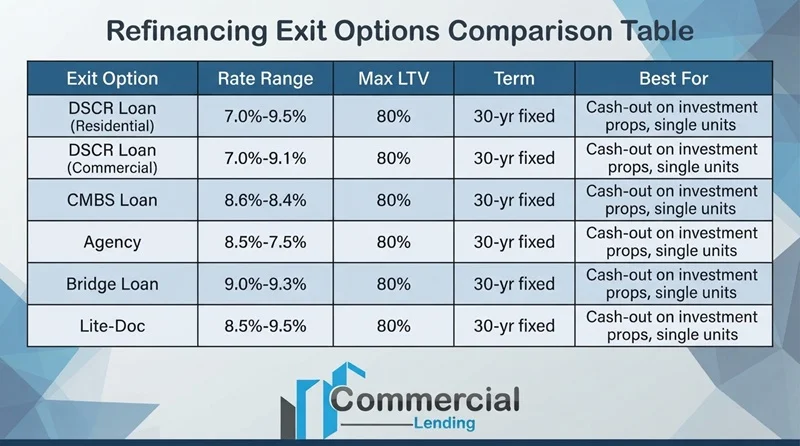
The right replacement depends on how you use the property now. Here are the main SBA loan refinance destinations:
| Exit Option | Rate Range | Max LTV | Term | Best For |
| DSCR Loan (Residential) | 6.5% to 7.5% | Up to 80% | Up to 30 years | Property now leased as a rental |
| DSCR Loan (Commercial) | 8% to 9% | Up to 75% | Up to 30 years | Income-producing commercial property |
| CMBS Loan | 7% to 8.5% | Up to 70% | Up to 30 years amortization | Larger stabilized properties, non-recourse |
| Agency (Fannie/Freddie) | 5.5% to 6.5% | Up to 70% | Up to 30 years | Stabilized multifamily |
| Bridge Loan | 9% to 12% | Up to 70% | 12 to 36 months | Short-term gap before permanent financing |
| Lite-Doc / Stated Income | 8% to 11% | Up to 75% | Up to 30 years | Self-employed with hard-to-document income |
The two most common exits are simple. If you leased the property out, a DSCR loan qualifies you on the rental income with no tax returns required. If you want to escape a variable rate and drop the personal guarantee on a larger property, a CMBS loan offers fixed, non-recourse financing.
Run the Numbers: A Worked Example
Refinancing only makes sense if the savings beat the cost of leaving. Here is how to check.
The situation:
Item | Amount |
SBA 7(a) balance | $1,200,000 |
Current rate (variable) | 10.5% |
Original term | 25 years |
Current loan year | Year 2 |
New CMBS rate (fixed) | 7.5% |
Step 1: Current monthly payment at 10.5%
$1,200,000 over 25 years at 10.5% = about $11,330 per month
Step 2: New monthly payment at 7.5%
$1,200,000 over 25 years at 7.5% = about $8,868 per month
Step 3: Monthly and annual savings
$11,330 - $8,868 = $2,462 per month
$2,462 x 12 = $29,544 per year
Step 4: The cost of leaving
Prepayment penalty (year 2 = 3% of $1,200,000) = $36,000
Estimated closing costs (about 2%) = $24,000
Total cost to refinance = $60,000
Step 5: Break-even point
$60,000 / $2,462 per month = about 24 months
In this example, you recover the cost in roughly two years, then save nearly $30,000 every year after that. If you plan to hold the property longer than the break-even period, refinancing is clearly worth it. If you plan to sell in 18 months, it is not.
The rule of thumb: calculate your break-even in months, then compare it honestly to how long you will keep the property.
When Refinancing Out Does Not Make Sense
Be honest about these situations:
- You are in year one of a 15+ year SBA loan. The 5% penalty is steep. Waiting until year three drops it to 1%, and year four drops it to zero.
- Your savings are thin. If the new rate is only slightly better, the closing costs may eat the entire benefit.
- You are selling soon. If a sale is coming, the penalty plus closing costs is money you will never recover.
- Your SBA rate is already low and fixed. Many SBA 504 loans carry excellent fixed rates. Do not give one up without careful math.
The Other Direction: Refinancing Debt Into an SBA Loan
If you want to consolidate expensive business debt into a cheaper SBA loan, the rules changed significantly. In June 2025, the SBA released SOP 50 10 8, which rewrote the rules for SBA loan refinancing. Here is what applies in 2026:
You must show a real benefit. For 7(a) refinances, this generally means reducing the interest rate by at least 1% or cutting monthly payments by at least 10%. The standard benchmark lenders apply is a minimum 10% reduction in your total debt service payment.
You need a clean payment history. The SBA minimum is 12 months of on-time payments, though lenders often prefer 24 months of post-closing performance with filed tax returns for the best terms. The debt being refinanced must have been current for at least the last 12 months or the life of the loan if shorter.
Some debt simply cannot be refinanced. Merchant cash advances and factoring agreements are not eligible under the 2025 SOP. Existing MCA obligations also count against your debt service coverage ratio during underwriting, which can disqualify an otherwise viable application. Debt owed to a small business investment company also cannot be refinanced with an SBA loan.
The lender cannot be bailed out. SBA loan proceeds may never be used to pay a creditor in a position to sustain a loss, because the SBA will not allow its guarantee to shift risk from a bad bank loan onto the federal government.
For 504 refinances, the existing debt generally must be at least six months old.
If you have merchant cash advance debt, deal with it separately before you apply, not as part of the SBA transaction.
The Refinance Process Step by Step
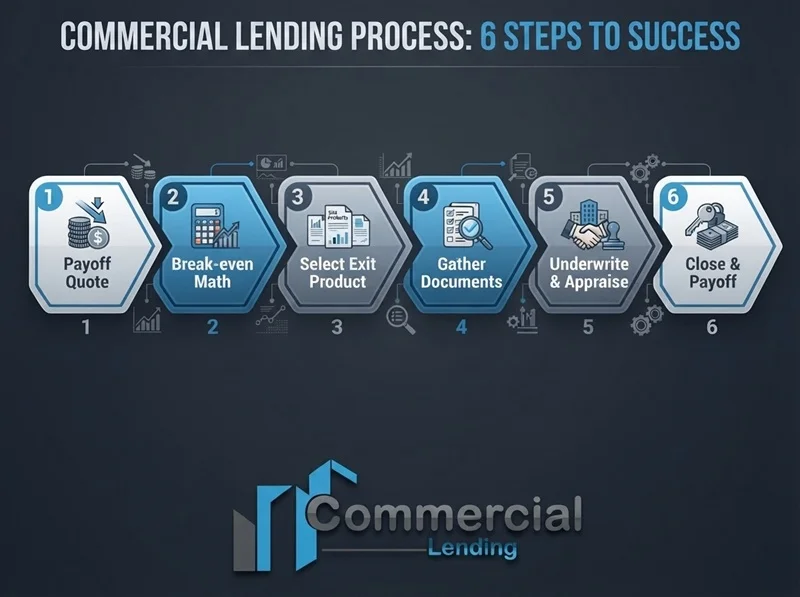
- Get your payoff quote. Contact your lender or CDC and request the exact payoff figure, including any prepayment penalty. Give 21 to 30 days' notice.
- Run your break-even math. Compare total exit cost against annual savings.
- Pick the right exit product. Match it to how the property is used today, not how it was used when you got the SBA loan.
- Gather documents. Property financials, rent roll if leased, operating statements, and entity documents. DSCR and lite-doc options: skip tax returns.
- Underwrite and appraise. The new lender verifies the property value and income.
- Close and pay off. The new loan pays off the SBA loan. Get written confirmation of payoff in full plus a lien release.
Common Mistakes to Avoid
- Skipping the payoff quote. Estimating your penalty instead of confirming it in writing leads to nasty surprises at closing.
- Forgetting the occupancy rule. If you leased out the property, you may already be out of compliance with your SBA loan. Address it rather than ignoring it.
- Only comparing rates. Points, closing costs, and prepayment terms on the new loan matter as much as the headline rate.
- Refinancing too early. Sometimes waiting 12 months to reach a lower penalty tier saves more than refinancing immediately.
Why Work With Commercial Lending USA
Refinancing out of an SBA loan means matching your property to the right replacement program, and that is where a correspondent lender helps. Commercial Lending USA offers:
- In-house underwriting to review your payoff quote and run the break-even math with you
- Access to a large capital network across DSCR, CMBS, agency, bridge, and conventional programs
- Guidance on timing, so you exit at the right point in your penalty schedule
- Help matching the exit product to how you actually use the property today
Ready to Review Your SBA Refinance?
Send us your current loan details and your payoff quote, and we will tell you honestly whether refinancing makes sense for your situation. Call (855) 365-9200, email sales@commerciallendingusa.com, or apply online for a free review.
Frequently Asked Questions
Can you refinance an SBA loan?
Yes. You can refinance out of an SBA loan into conventional, DSCR, CMBS, agency, or bridge financing. The main things to check first are your prepayment penalty and whether the new loan actually saves you enough to justify the cost of leaving.
What is the penalty for refinancing an SBA loan early?
For SBA 7(a) loans with a term of 15 years or more, the penalty is 5% in year one, 3% in year two, and 1% in year three when you prepay 25% or more of the balance. Loans shorter than 15 years generally have no penalty. SBA 504 loans have a longer declining penalty on the CDC portion, often lasting up to 10 years.
Can I refinance an SBA loan with another SBA loan?
Sometimes, but the rules are strict. The SBA does not allow its guarantee to be used to rescue a lender from a loss, and same-institution refinances face added restrictions under the current SOP. You must also demonstrate a genuine benefit, typically at least a 10% reduction in total debt service.
How soon can I refinance an SBA loan?
There is no fixed waiting period to refinance out, but the prepayment penalty makes early exits expensive on longer-term loans. To refinance other debt into an SBA loan, you generally need at least 12 months of on-time payments on the existing debt.
Do I have to refinance if I stop occupying the property?
Most likely yes. SBA loans require your business to occupy at least 51% of the building. If you lease the space out, you no longer meet the occupancy requirement, and a DSCR loan is usually the right replacement since it qualifies on rental income.
Can I refinance a merchant cash advance with an SBA loan?
No. Merchant cash advances and factoring agreements are not eligible for SBA refinancing under the current rules. MCA debt also counts against your debt service coverage ratio during underwriting, so it is best to resolve it separately before applying.
Can I get cash out when refinancing an SBA loan?
SBA programs are restrictive about cash-out. If pulling equity is your goal, a conventional, DSCR, or CMBS refinance usually gives you far more flexibility.
How do I calculate whether refinancing is worth it?
Add your prepayment penalty and closing costs together, then divide by your monthly savings. That gives your break-even in months. If you will hold the property longer than that, refinancing generally makes sense.
Is Commercial Lending USA an SBA lender?
Commercial Lending USA is a correspondent lender. We review your file, underwrite in-house, and place your loan with the right capital source, including SBA and non-SBA programs.
Disclaimer: SBA rules, rates, and terms shown here reflect current guidelines and market conditions as of 2026 and may change at any time. SBA refinancing eligibility is governed by SBA Standard Operating Procedures, which are updated periodically. All loans are subject to lender approval and underwriting. This article is for general information only and is not financial, legal, or tax advice. Consult your accountant before making a prepayment decision.
0 Comments
Leave A Comment