
7 Reasons to Consider Interest-Only Commercial Loan Options
We track these numbers every day, and here's what stands out: government auditors found banks alone hold roughly $3 trillion of the nation's $5.9 trillion in outstanding commercial real estate debt. That's a lot of capital sitting on lender balance sheets, and it's also a lot of competition for the best deals in your market. Investors who move fastest usually aren't the ones with the most money. They're the ones who keep the most cash free.
If you lock up your capital in heavy principal payments every month, you risk sitting on the sidelines when the right property comes up. That's why we spend so much time walking clients through interest-only commercial loan options; they're built to keep your cash working for you, not tied up in your mortgage.
What Is Interest-Only Commercial Real Estate Financing?
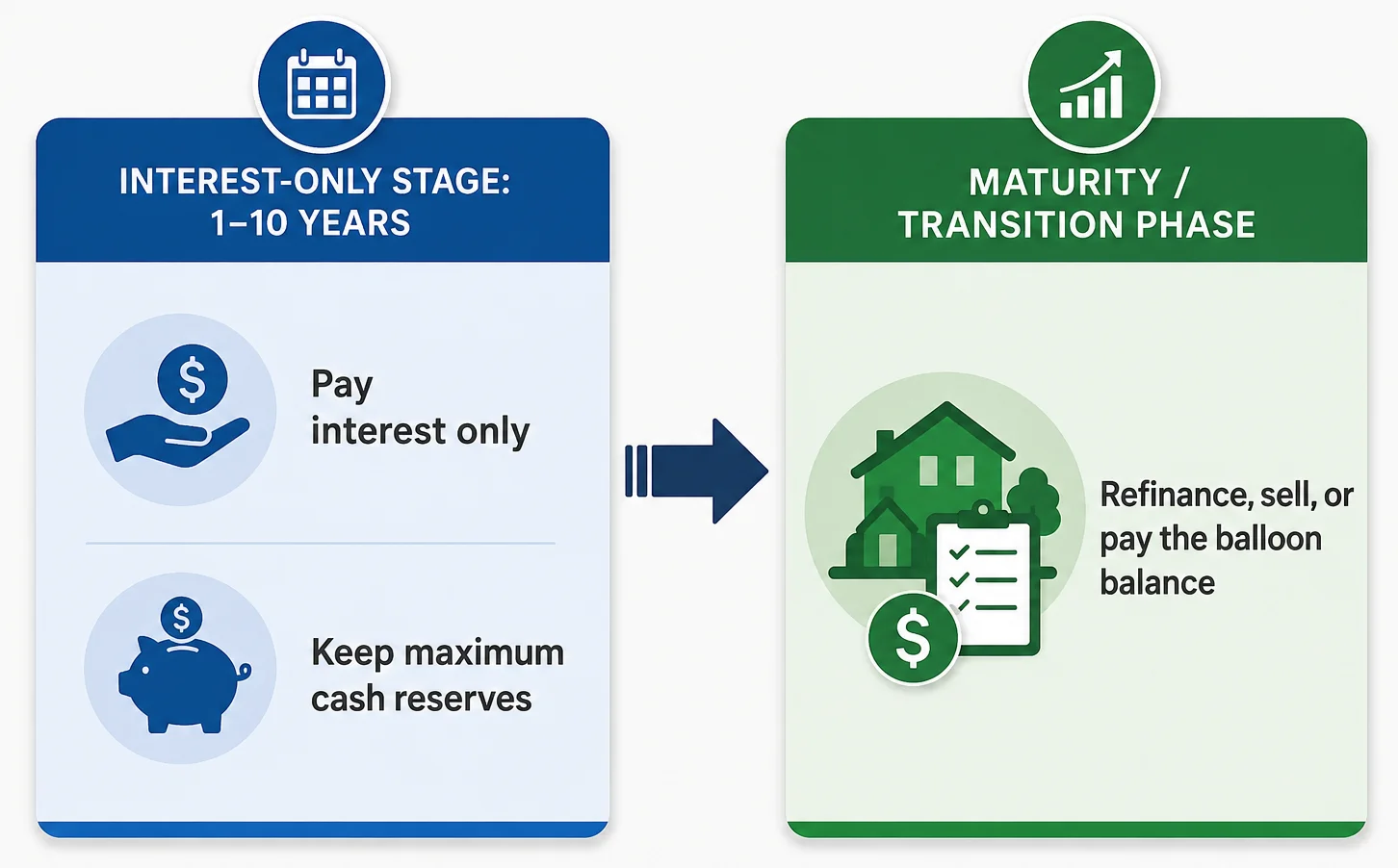
Let's start with the basics. Interest-only commercial financing is a loan where you pay only the interest each month for a set period, without paying down the loan balance.
In a standard amortizing loan, your monthly payment covers two things:
- The interest fee your lender charges you to borrow
- A slice of principal that reduces your total debt
With an interest-only structure, you skip that second piece during the introductory period, typically 1 to 10 years, depending on the program we structure for you. Your payment follows a simple formula:
PMT=12P×r
- PMT = your monthly interest payment
- P = your total loan balance
- r = your annual interest rate
Say you borrow $1,000,000 at 7%. On an interest-only schedule, you'd pay about $5,833 a month. On a standard 25-year amortizing loan, that same balance runs about $7,067 a month. That's an extra $1,234 you keep in your business every single month.
Interest-Only vs. Principal-and-Interest: What's the Real Difference?
Feature | Interest-Only Loan | Standard Principal & Interest Loan |
Monthly Payment | Lower | Higher |
Cash You Keep | Maximum | Reduced |
Equity Growth | From market appreciation only | From paydown + appreciation |
Debt Paydown | None during IO period | Steady, monthly |
Typical Down Payment | 25%–40% | 20%–30% |
End of Term | Balloon payment, refinance, or recast | Balance reaches zero |
You get lower overhead today in exchange for a plan you'll need ready when the interest-only period ends, whether that's a refinance, a sale, or a recast.
Why Investors Choose Interest-Only Financing
1. You Protect Your Working Capital
Businesses rarely fail because they lack property; they fail because they run out of cash. When you're not required to pay down principal every month, your cash cushion stays thick. You can absorb a slow season, an unexpected repair, or a tenant turnover without scrambling.
2. You Can Fund Renovations Instead of Debt Paydown
If you're buying an older apartment building, retail strip, or warehouse, you need capital for upgrades, and a heavy mortgage payment competes directly with that budget. With interest-only terms, the money you'd otherwise send toward principal goes straight into the property instead.
Here's how that plays out on a $7,000,000 renovation project:
- You save $8,000 a month by going interest-only
- Over 3 years, that's $288,000 back in your pocket
- You put that $288,000 into upgrades
- Those upgrades raise property income by $75,000 a year
- At a 6% market cap rate, your property value climbs by $1,250,000:
Value Gain=0.06$75,000=$1,250,000
3. You Can Boost Your Cash-on-Cash Returns
Research from Wharton's Zell/Lurie Real Estate Center on real estate leverage confirms what experienced investors already know: when your property earns more than your cost of debt, borrowing amplifies your returns. You can track this yourself with the cash-on-cash formula:
CoC= (Net Income−Debt Payment)/ Cash Invested
Lower your debt payment to increase the net cash available to you and your equity partners every quarter.
4. You Bridge Fast Property Transitions
If you're planning to buy, stabilize, and sell within two or three years, paying down principal on a property you don't intend to hold barely makes sense. Our bridge loan programs are built around this scenario: fast funding that lets you close on distressed or time-sensitive deals, stabilize occupancy, and line up your exit.
5. You Maximize Your Tax Deductions
Under current IRS guidance, interest paid on debt used in a trade or business is generally deductible, subject to the limitations in Section 163(j). Because every dollar of an interest-only payment is interest and none is principal, your entire monthly loan expense can work toward lowering your tax bill. Always confirm your specific situation with a CPA, since limitations vary by entity type and income.
6. You Keep Payments Manageable When Rates Shift
As of today, the Federal Reserve's Bank Prime Loan Rate sits at 6.75%. If you're refinancing a maturing loan into a higher-rate environment, switching to an interest-only schedule keeps your monthly payment predictable while you plan your next move. Our refinance calculators can help you model that transition before you commit.
7. You Support Construction Without the Cash Drag
Land under construction doesn't collect rent. Our commercial construction loan programs let you draw funds in phases and pay interest only on what you've drawn, so your crew can keep building without a heavy debt bill working against you.
How You Qualify for an Interest-Only Commercial Loan
Lenders take on more risk when you're not reducing principal, so they set clear guardrails. Here's what you'll typically need:
- Down payment / equity: 25%–40% (a 60%–75% loan-to-value ratio)
- Credit score: Generally 680–720 or higher
- Cash reserves: 6–12 months of payments in liquid accounts
- Exit plan: A clear path to pay off the loan at maturity, sale, refinance, or recast
Lenders also lean on debt yield to gauge risk. You can calculate it yourself:
Debt Yield = (Total Loan Amount/Net Operating Income) × 100
Most lenders look for 9%–11% or higher before approving interest-only terms, a standard discussed in the Harvard Business Law Review's analysis of commercial real estate lending risk and reflected in current CMBS underwriting, where office loan debt yields recently averaged around 10.7%.
Property Type | Max LTV | Typical IO Term | Common Exit Strategy |
Multifamily (5+ Units) | 70%–75% | 3–10 Years | Fannie Mae / Freddie Mac Takeout |
Mixed-Use Buildings | 65%–70% | 2–5 Years | Commercial Term Loan / CMBS |
Warehouses & Industrial | 65%–75% | 3–7 Years | Bank Refinance / Life Company |
Retail Centers | 60%–65% | 2–5 Years | Long-Term Fixed Loan |
Hotels & Motels | 55%–65% | 1–3 Years | |
Ground-Up Builds | 65%–75% LTC | 1–3 Years | Permanent Commercial Mortgage |
If your tax returns don't tell the full story of your property's cash flow, you don't need them to. We offer Stated Income, Lite-Doc, No-Doc, and DSCR programs built around what your property actually earns.
What You Need to Watch Out For
Interest-only financing isn't a free lunch; you're deferring, not eliminating, the principal. Know these risks going in:
- The balloon payment: Your balance doesn't shrink. You'll owe the full original amount at maturity.
- Payment shock: If your loan converts to an amortizing schedule, your monthly payment can jump significantly.
- Market dips: If property values fall in your area, refinancing your full balance could take more cash than you planned for.
Before you commit, run your numbers through our purchase and refinance calculators to see exactly what a rate change would mean for your payment:
Interest Rate | Monthly IO Cost ($3M Loan) | Monthly Payment After Conversion (25-Yr Am.) | Monthly Increase |
6.00% | $15,000 | $19,329 | +$4,329 |
6.50% | $16,250 | $20,256 | +$4,006 |
7.00% | $17,500 | $21,203 | +$3,703 |
7.50% | $18,750 | $22,169 | +$3,419 |
8.00% | $20,000 | $23,154 | +$3,154 |
How We Secure the Right Loan for You
We operate as a correspondent lender, table lender, and super broker, bringing 30 years of underwriting experience to every deal we structure across 45 states. We work with more than 75 loan programs, including:
- Fast bridge and hard money loans
- Construction and renovation financing
- DSCR and low-doc options
- Fannie Mae, Freddie Mac, FHA/HUD, SBA, and USDA B&I programs
- Long-term CMBS and commercial term loans
We fund multifamily properties, mixed-use buildings, retail centers, industrial warehouses, hotels, and senior housing communities nationwide. Browse our full lineup of loan types or learn more about who we are and how we work.
We also run referral programs for brokers and realtors; reach out if you'd like to learn more.
Ready to Talk Through Your Deal?
Don't let a high monthly payment slow your growth. Tell us about your property and timeline, and we'll help you find the right structure.
Call us at 855-365-9200 or 571-544-6600, or submit your scenario online and let our team get to work on your financing.
You can also browse our Knowledge Base and blog to learn more about how commercial financing works, or check our FAQ page for quick answers.
FAQs
Can you make voluntary early principal payments?
Yes, in most cases. Some credit facilities include prepayment penalties or yield maintenance clauses, so review your promissory note, or ask us to walk through it with you, before sending extra cash toward your loan.
Do you always need a personal guarantee?
No. Smaller community banks often request full recourse, but many institutional bridge, agency, and CMBS lenders we work with offer non-recourse structures secured solely against the property.
Can you qualify as a foreign investor?
Yes. You'll typically need a larger equity down payment, stronger domestic cash reserves, and verified proof of international funds, but foreign investors regularly close interest-only commercial deals with us.
Can you extend your interest-only period?
Often, yes, if your property hits target occupancy benchmarks. You'll usually pay a modest extension fee and need to show stable net operating income.
Does interest-only financing affect your business credit?
Yes. Lenders typically report your payment performance to commercial credit bureaus like Dun & Bradstreet and Experian Commercial, so consistent on-time payments help build your borrowing profile over time.
0 Comments
Leave A Comment