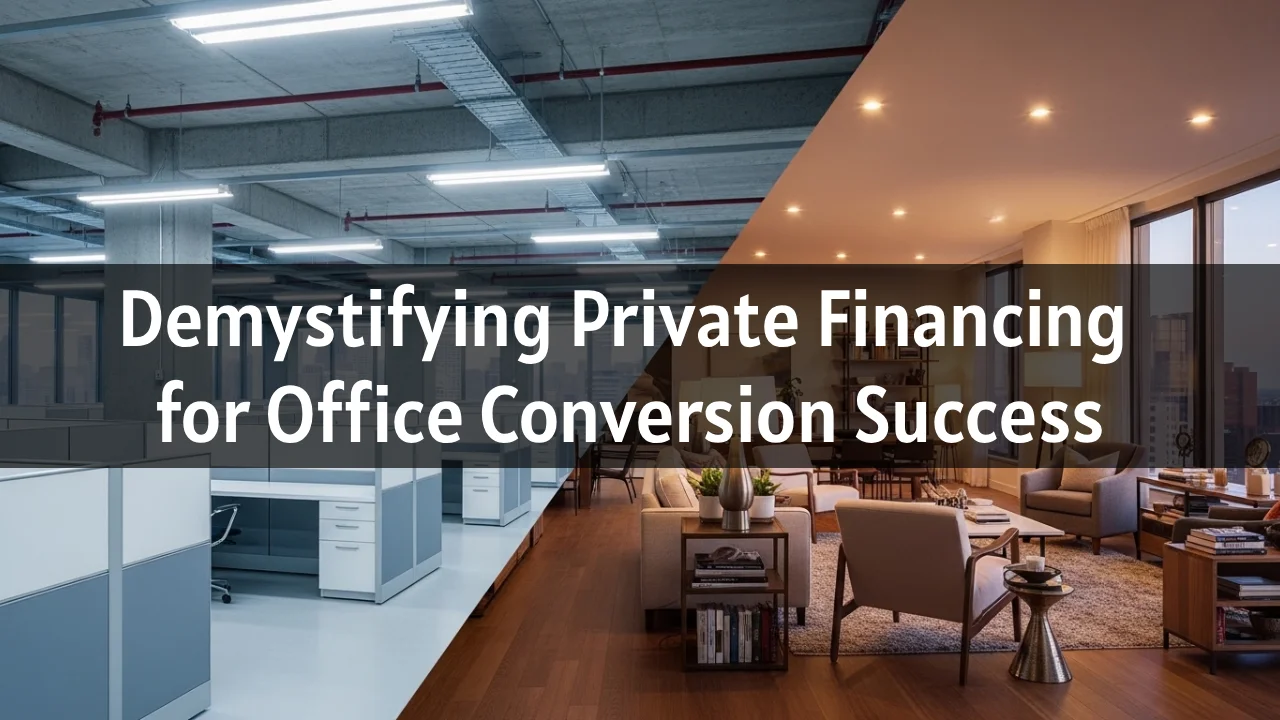
Demystifying Private Financing for Office Conversion Success
Imagine standing on a street corner in Manhattan or Chicago. You look up at a 20-story office tower. To a casual passerby, it is a monument of glass and steel. But to you, the investor, it is a "non-performing asset." The lights are off on ten floors. The anchor tenant just downsized by 50,000 square feet. This is the "Urban Doom Loop" in action.
By early 2026, the reality for commercial real estate will have shifted. Office valuations in major U.S. cities have fallen by 40% to 60% from their 2019 peaks. Across the country, more than $1.5 trillion in commercial loans are set to come due between 2024 and 2026. We are in a "subtraction" phase for office space.
At Commercial Lending USA, we have seen these cycles for 30 years. We are not just a consultancy; we are a correspondent and table lender. We know how to bridge the gap between a vacant office and a vibrant residential community.
Why are traditional banks saying no to office conversions?
If you walk into a traditional bank today with a plan for an office-to-apartment conversion, you will likely hit a wall. Why? Because banks look for "capacity" the ability to pay a loan back using current cash flow. A vacant office building has zero cash flow. It is a "distressed" asset in their eyes.
Traditional lenders are also wary of the $213 billion in office loans coming due this year. They are tightening their standards. They focus on the "5 Cs": Character, Capacity, Capital, Collateral, and Conditions. When a building is mid-conversion, it fails the "Capacity" test.
This is where private financing for office building conversion saves the day. Private lenders focus on the "as-stabilized" value. They look at what the building will be worth once it is fully occupied. As an asset-based financing company, we focus on real estate first. We prioritize the quality of your project over the strict personal income verification that banks demand.
Is your building’s "bone structure" right for a residential reset?
Before we talk about money, we must talk about architecture. Not every office tower can become a home. At Commercial Lending USA, our 30 years of underwriting experience help us spot winners early.
The Magic Number: 65 to 70 Feet
For private financing options for commercial-to-residential conversion, floor-plate depth is the ultimate filter. Residential units need windows. If a building is too "deep," the center of the floor becomes a dark, unusable cave. Floor plates under 65 to 70 feet from the core to the perimeter are the "gold standard". If the building is deeper, you should carve out an interior atrium. This can add $50 to $100 per square foot to your construction costs.
The Core and the Grid
Lenders also look at the "core," where elevators and pipes are located. A central, symmetrical core allows for the most efficient apartment layouts. We also check the "structural grid." If the support columns are in awkward places, your floor plans will suffer. This drives up your "gross-to-net" ratio and shrinks your profit margin.
Feature | Best for Conversion | Risk Factor |
Floor Plate Depth | Under 70 feet | Over 75 feet (Needs light wells) |
Core Location | Central/Symmetrical | Offset or irregular |
Windows | Operable/Large | Fixed glass (High replacement cost) |
Zoning | Residential "by right." | Commercial only (Needs 12-36 months to rezone) |
Can private financing close the gap in the $1.5 trillion debt crunch?
With so many loans maturing, many owners face a "bottleneck" year. If you can't refinance with a bank, you need an alternative path. Finding private capital for neglected office building renovation is about speed and flexibility.
Commercial Lending USA connects you to over 200 private lenders and investors. We offer 75 different loan options. Whether you are a seasoned developer or a new investor, we have a path for you.
1. Hard Money Loans
If you need to move fast to buy a distressed asset, hard money loans is your best option. These loans close in 3 to 7 days. They are asset-based, meaning we care more about the building than your credit score. Rates typically range from 10% to 18%, but they give you the leverage (up to 75% LTV) to seize a deal before a competitor does.
2. Bridge Loans for Office Building Conversion to Mixed-Use
A bridge loan is a short-term solution for you like (6 months to 2 years) that gives you time to "effect change". You use this capital to renovate, find tenants, or clear zoning hurdles. Once the building is stabilized, you transition into a permanent loan.
3. DSCR (Debt Service Coverage Ratio) Loans
DSCR loans are ideal for real estate investors who want to avoid tax returns and complex income checks. Instead, lenders focus on the property’s rental income. If the income covers the loan payment, usually at a 1.25 DSCR ratio, the loan can qualify. This lite-doc or no-doc option makes it easier to grow your rental property portfolio.
What about the "Pleasure" of Incentives and Subsidies?
One of the biggest benefits of private financing for office building redevelopment is the ability to "stack" it with government incentives. In 2026, cities are desperate to fix the housing shortage. They are clearing the path for you.
- New York City (467-m Program): This provides a 30-year property tax exemption for projects that include 25% affordable housing.
- Washington D.C. (Housing in Downtown): Offers a 20-year tax abatement to bring 15,000 new residents to the core.
- Chicago (LaSalle Street Reimagined): Provides millions in Tax Increment Financing (TIF) grants to help fill the "equity gap" in large conversions.
Alternative financing for office space conversion to apartments often includes the Historic Tax Credit (HTC) or the Low-Income Housing Tax Credit (LIHTC). These can cover a significant portion of your "hard costs," which usually account for 72% of your total budget.
Private Debt Funds for Office Building to Hotel Conversion
Not every office building should be turned into an apartment building. Sometimes, a hotel is the smarter play. Hotels often fit better into older office floor plans because guest rooms can be smaller than apartments.
When we work with private debt funds for office building to hotel conversion, we look for a few key things:
- Sponsor Experience: You should have at least 5 years of industry experience.
- Brand Support: Lenders love "franchised" hospitality. It provides a proven revenue model.
- Location: We target the top 150 Metropolitan Statistical Areas (MSAs) in the USA.
Our hospitality loan program offers flexible financing options for hotel investors, including competitive loan amounts, LTV ratios, and credit requirements.
Hospitality Loan Metric | Standard Terms |
Loan Amount | $5 million to $30 million |
Max LTV | 75% "as-is" or 70% "as-stabilized." |
Term | 3 years + annual extensions |
Guarantor Credit | 680+ FICO |
Managing the Risks of Private Financing for Office Conversion Projects
We are underwriters first. We have to be honest about the risks. Adaptive reuse is complex.
- Construction Complexity: You might find "surprises" behind 1970s walls. We recommend a contingency budget of 4% to 10% for unanticipated demolition or trash removal.
- Interest Rate Shifts: Many private loans are tied to the SOFR (Secured Overnight Financing Rate). If rates stay "higher for longer," your debt service could eat into your profits.
- The Exit Strategy: A bridge loan is only as good as your exit. You must have a clear path to sell the building or secure a permanent mortgage (such as a Fannie Mae or Freddie Mac loan) once the project is complete.
Case Studies: Private Financing Office to Residential Conversion
Real numbers prove the theory.
- Worcester, MA (10 Chestnut St): A former health plan headquarters was converted into 198 apartments. A private lender provided $47.57 million, while the state provided a $3.6 million tax credit bridge loan.
- Manhattan (25 Water St): This is the largest conversion in NYC history. It is turning 1.1 million square feet of office space into 1,320 apartments.
- Boston (73 Essex St): This project delivered a 17% IRR (Internal Rate of Return) without inclusionary zoning mandates, demonstrating the raw power of the conversion math.
Private vs Traditional Financing for Office Conversion
Private lending offers faster approvals, higher leverage, and more flexible terms compared to traditional bank financing, making it a strong option for office conversion projects.
Feature | Commercial Bank | Commercial Lending USA |
Speed to Close | 45-90 days | 07-45 days |
Focus | Borrower's Credit/Income | Asset Value/Potential |
Paperwork | Extensive (Full-Doc) | Minimal (Lite/ No-Doc) |
LTV (Leverage) | 55% - 65% | 70% - 90% |
Flexibility | Rigid terms | Custom-tailored |
Conclusion - Turning Vacancy into Vitality
The "Urban Doom Loop" doesn't have to be your story. With private construction loans for office to residential conversion, you can turn a struggling asset into a thriving community.
At Commercial Lending USA, we simplify the complex. Whether you need a bridge loan for a mixed-use project, an SBA 504 loan for a boutique hotel, or a no-doc DSCR loan for a small apartment building, we are your partner. Our platform connects you to the capital you need to succeed in the most significant real estate reset of our lifetime.
Let’s turn your property into a high-performing asset. Contact Commercial Lending USA today. With 30 years of underwriting expertise and a network of 200+ private lenders and investors, we don't just find you a loan we find you a future.
FAQs
Does conversion financing require personal tax returns?
No. Many specialized programs, such as DSCR loans, focus on the property’s projected rental income rather than your personal finances. This lite-doc approach allows investors to qualify based on the asset’s as-stabilized value and its debt service coverage ratio.
Are older office buildings eligible for tax credits?
Yes. Many historic properties may qualify for the Federal Historic Tax Credit, which can cover up to 20% of eligible renovation costs. You may also be able to combine this with local incentives, such as New York’s 467-m program, to reduce your long-term property tax burden.
Can private lenders fund hotel to apartment conversions?
Yes. Private lenders often like hotel-to-apartment conversions since the layouts are easier to work with than open office spaces. We offer bridge loans to help cover renovation costs, so you can quickly turn these properties into rental units.
Is a central elevator core necessary for success?
Yes. A central, symmetrical core is important because it supports efficient residential layouts and simpler plumbing design. If the core is irregular, construction costs can increase and reduce your overall profit.
Do these loans close faster than bank mortgages?
Yes. Private financing can close in as little as 45 business days. Unlike traditional banks, we use in-house underwriting to move faster and help you secure deals before others, especially on time-sensitive opportunities.
0 Comments
Leave A Comment