
5 Key Benefits of Private Bridge Loans for Maturing CBMS Debt
Your CMBS balloon payment is coming due. In today's market, this isn't just a deadline—it's a critical moment for your investment's survival.
The Immediate Risk of CMBS Loan Default and Special Servicing
For many commercial property owners, the looming "hard maturity" failure of their private bridge loan for maturing CMBS debt has become a high-probability event. This is the Pain. Current high-rate environments mean that even a performing property may fail to meet the new, much higher Debt Service Coverage Ratio (DSCR) required for a refinance. If your property's Net Operating Income (NOI) can't support the new, larger debt service, you face imminent default. According to the U.S. Securities and Exchange Commission, the total volume of CMBS deals hit $156.5 billion in 2024. Yet, overall loan payoff rates for fixed-rate CMBS loans are estimated to be in the 50% to 55% range, showing a significant number of loans are struggling to exit.
The direct consequence of a non-performing matured balloon loan is being trapped in the Special Servicer Trap.
- The Special Servicer Trap: The special servicer’s sole mandate is to protect bondholders—they are not your partner. Their goal is to maximize recovery for the CMBS trust, often leading to costly modifications, fee accumulation, and a rapid acceleration of the process.
- Foreclosure Risk: The special servicer's ultimate tool for a defaulted, matured loan is foreclosure, which can occur much more quickly than in a traditional bank relationship.
- Wasted Equity: Years of capital investment and value appreciation are at risk of complete loss due to a lack of a clear exit strategy for the loan.
Why Traditional Refinancing Is Not Working Now
Volatile interest rates, stricter bank lending standards, and significant property market uncertainty have dried up conventional refinance options for transitional or underperforming properties. Banks are tightening their balance sheets and raising underwriting hurdles, especially for property types such as offices and specific retail sectors.
Unlike a bank or correspondent lender, the CMBS structure is inherently inflexible. Once the loan is in a securitized pool, there is virtually no room for negotiation outside of the stringent, slow, and expensive special servicing process. You need a solution that can move quickly, look beyond a simple DSCR, and offer a path to stability.
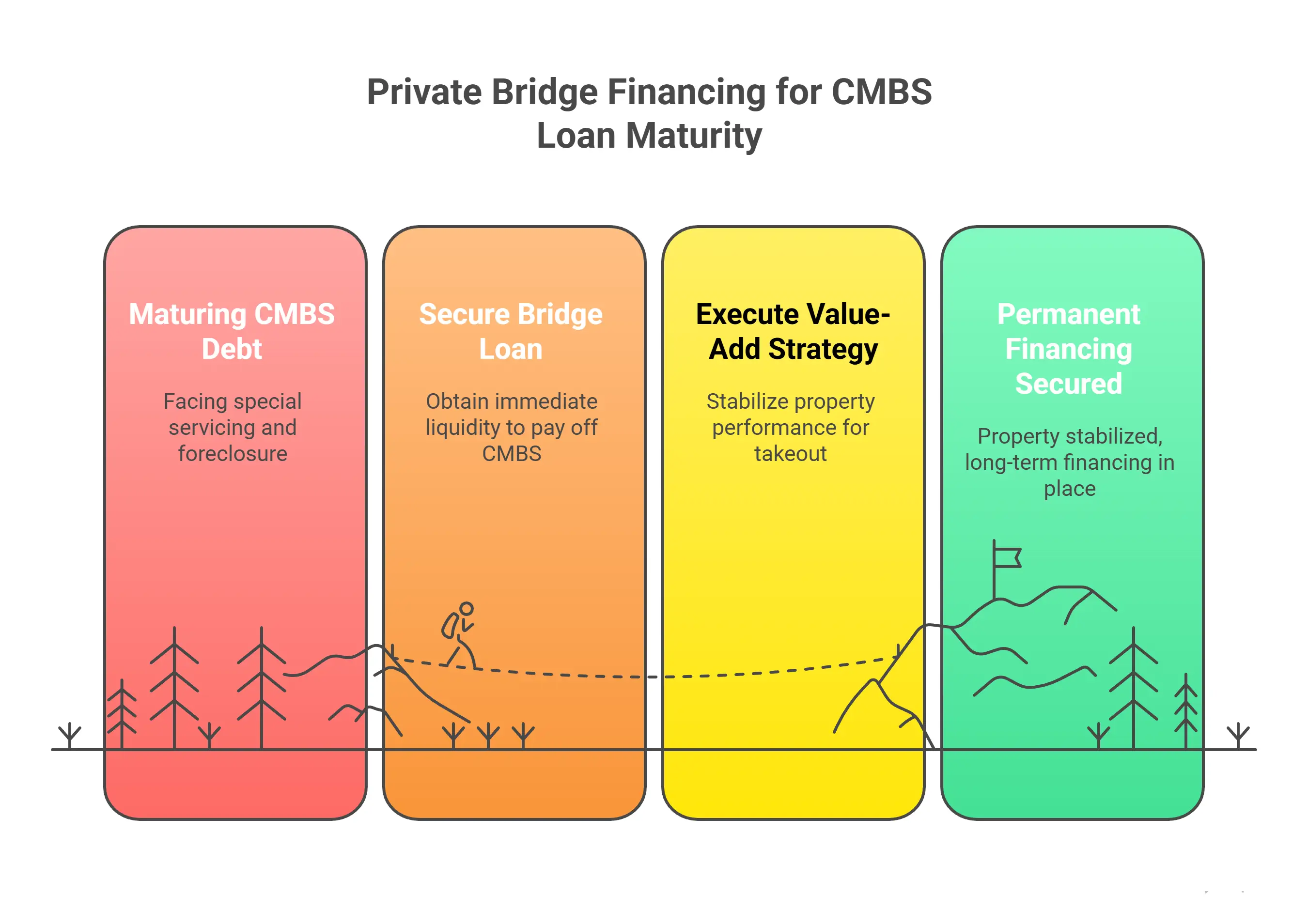
Private Bridge Financing for CMBS Loan Maturity: Your Crucial Lifeline
A private bridge loan for maturing CMBS debt is your most crucial tool for avoiding immediate special servicing and foreclosure. This financing option provides the immediate liquidity needed to pay off the existing, inflexible CMBS note, giving you time to execute a value-add strategy or stabilize property performance for a future permanent takeout.
What is a Private Bridge Loan CMBS and How Does it Work?
A private bridge loan CMBS is a short-term, asset-backed loan designed to "bridge" the gap between your existing CMBS loan's maturity date and the time you secure long-term, permanent financing.
Think of it as an emergency exit strategy. This capital is typically supplied by non-bank private investment funds, which offer far greater flexibility than traditional institutional lenders. The key difference is the underwriting focus:
- Focus on Asset Value: Private bridge lenders focus heavily on the intrinsic value of the commercial real estate asset and its future, stabilized potential, rather than solely on the property's current, often low, historical cash flow (DSCR).
- Speed and Certainty: These loans can close in weeks, not months, which is essential when the CMBS maturity deadline is rapidly approaching. The typical term is 12 to 36 months.
Our 30-Year Expertise in Underwriting Complex CMBS Exits
At Commercial Lending USA, our strength comes from 30 years of underwriting experience as a correspondent and table lender. We understand the specific complexities and time constraints involved in paying off CMBS debt.
We don't just offer one solution; we analyze your specific asset, its current performance, and its future potential to structure the right exit strategy. We leverage our network and expertise to offer access to 75 loan options—from specialized bridge loans and hard money to permanent financing—to find a capital stack that works for your situation, not the special servicer's.
Benefit 1: Fast-Track Your Exit with a Quick Close Private Bridge Loan CMBS
The most immediate and critical benefit of a private bridge loan for maturing CMBS debt is the speed of execution. When facing a looming maturity date, time is your most precious and limited asset.
Beating the Deadline: Why Speed is Critical with Maturing Debt
Traditional refinancing or restructuring options, especially another CMBS deal, involve lengthy underwriting, pooling, and rating processes that can take 60 to 120+ days. This extended timeline virtually guarantees your loan will hit its "hard maturity" date, immediately triggering the Special Servicer Trap and massive default penalties.
A quick-close private bridge loan CMBS provider, however, has the flexibility to move beyond institutional constraints. Because they focus on the asset's intrinsic value and use private capital, they can streamline due diligence and close in a fraction of the time.
Waiting even 30 days can trigger massive default interest fees and special servicer penalties that erode your equity. We help you avoid that financial bleed.
Compare the closing timelines for crucial time-sensitive relief:
Loan Type | Typical Timeline | Risk to Borrower |
Traditional Bank | 60–90+ Days | High Default Risk |
CMBS Refinance | 90–120+ Days | High Risk of Special Servicing |
Private Bridge | 10–30 Days | Minimal |
Benefit 2: Gain Time to Execute Your Property’s Value-Add Strategy
A private bridge loan for maturing CMBS debt isn't just a defensive maneuver; it’s an offensive tool to increase the underlying value of your investment. By paying off the CMBS debt, private bridge financing for a CMBS loan maturity gives you 12 to 36 months of critical time outside the CMBS structure's rigidity.
Fund Necessary Improvements and Increase Your DSCR
The CMBS structure offers zero flexibility to perform meaningful renovations or stabilize occupancy during its term. A private bridge loan solves this by providing capital—often including a future funding facility—that can be actively used for improvements:
- Funded Renovations: You can access funds for essential capital expenditures, significant repairs, or property-wide renovations.
- Lease-Up and Stabilization: The funds allow you to execute a planned lease-up strategy (often called "fix and rent" or "fix and hold"). You can pay for tenant improvements (TI) and leasing commissions to attract high-quality, long-term tenants.
The ultimate goal of using the bridge term is to significantly increase the Net Operating Income (NOI). A higher, stabilized NOI directly translates to a much stronger Debt Service Coverage Ratio (DSCR), which is the key metric required to qualify for favorable, lower-rate long-term financing (the "takeout loan") when the bridge term ends. This maximizes your return and secures the asset's long-term future.
Benefit 3: Maximize Flexibility Without the CMBS Servicer's Constraints
A core advantage of securing a private bridge loan for maturing CMBS debt is the immediate freedom you gain from the rigid, restrictive covenants of the securitized structure.
Why Private Capital for CMBS Debt Extension is More Adaptable
When your loan is in a CMBS trust, every decision—from minor leasing approval to capital expenditure—must pass through the slow, self-interested lens of the special servicer. This system is designed to protect bondholders and ensure compliance, not to maximize your asset's value or provide timely approval.
Private bridge loan eligibility CMBS alternatives, on the other hand, offer an unprecedented level of adaptability:
- Underwriting Focus: Private lenders are portfolio lenders. They assess risk based on the asset's future, stabilized value, and your specific business plan. This makes the financing ideal for transitional properties with temporary vacancies or below-market rents.
- Responsive Decisions: You deal directly with private bridge loan lenders for maturing CMBS, not a bureaucracy. This dramatically accelerates approvals for key actions, such as executing new leases, performing renovations, or drawing on future funds. You gain the agility needed to react to market changes and implement your stabilization plan efficiently.
By moving to a private bridge structure, you exchange the special servicer's restrictive rulebook for a flexible partnership focused on getting your property to a condition ready for permanent, low-rate financing.
Benefit 4: Secure Financing for Maturing CMBS Debt Alternative to Selling Low
When a CMBS loan matures in a challenging economic environment, the special servicer's pressure or the lack of conventional refinancing can force an investor into a distressed sale. This means selling the property at a significant discount, liquidating years of hard-earned equity and capital investment.
Avoiding the Risks of Maturing CMBS without Bridge Financing
A private bridge loan for maturing CMBS debt acts as an intelligent shield, providing crucial liquidity to pay off the rigid loan and buy time. This is the only realistic financing for maturing CMBS debt alternative that prevents a forced, low-value sale.
The bridge loan allows the investor to wait for two critical conditions to improve:
- Market Conditions (Interest Rates): It provides a fixed window (typically 12–36 months) to wait for the Federal Reserve's rate-hiking cycle to reverse or for interest rates to drop. This directly reduces the cost of the eventual permanent takeout financing.
- Property Performance (Value-Add): It gives time to execute the value-add strategy (Benefit 2). By increasing the property’s NOI and occupancy, you substantially raise its valuation and Debt Service Coverage Ratio (DSCR), making it attractive to a broader pool of long-term lenders.
In the first quarter of 2024, the delinquency rate for U.S. CMBS office loans alone jumped sharply to 7.34% (compared to 1.52% in March 2022), according to financial data reports. This is a clear indicator of the market pressure forcing assets into distress.
Choosing a bridge loan is an intelligent, temporary financial move, not a desperate one. It preserves your equity and positions your asset for a high-value sale or a successful long-term refinance when market conditions are favorable.
Benefit 5: Position for Long-Term, Lower-Rate Permanent Financing
A private bridge loan to refinance maturing CMBS debt is never the final solution; it is the strategic move that lays the foundation for securing the best possible long-term financing. The bridge loan's success is measured by the quality of the permanent loan that follows.
The Clear Path from Bridge to Long-Term Stability
The inherent problem with a maturing CMBS loan is that the asset is often transitional—it needs improvements, stabilization, or time for market rates to drop. The bridge loan provides the exact mechanism to solve these issues:
- Stabilization: Short-term capital enables you to execute the value-add plan, leading to higher Net Operating Income (NOI) and a robust Debt Service Coverage Ratio (DSCR).
- Attractiveness: The improved metrics make the asset highly attractive to traditional, lower-cost lenders who demand stability.
This stabilization phase ensures you are positioned for a successful takeout using lower-rate, permanent financing from sources such as:
- Conventional Banks and Credit Unions
- Agency Financing (Freddie Mac or Fannie Mae)
- New, well-structured CMBS financing
Understanding the difference between a bridge loan and permanent financing CMBS is key to this strategy. Bridge loans are high-rate, high-flexibility short-term tools. Permanent financing is low-rate, low-flexibility, and only available to stabilized properties.
Our role extends beyond providing the bridge loan. Our financial consulting services guide you in structuring the property's performance to ensure a seamless, successful transition to the best available long-term loan option upon the bridge loan's maturity.
Your Strategy for a Successful CMBS Maturity Exit
The current market is challenging. Data from the Mortgage Bankers Association (MBA) shows the CMBS delinquency rate rose to 5.15% in the third quarter of 2024. If your loan is maturing, you need rapid, decisive action to prevent becoming part of this statistic. Securing the best private bridge loan rates for CMBS is your immediate solution.
How to Secure a Private Bridge Loan for Commercial Real Estate CMBS
Our streamlined process leverages our 30 years of underwriting experience to move with the speed the CMBS deadline demands. We focus on the asset's actual value, not the restrictive covenants of your existing loan.
Here is the straightforward process to secure your bridge financing:
- Immediate Assessment: Contact us immediately with your CMBS loan documents (including the maturity date and current DSCR). This allows us to quickly assess the urgency and the asset's underlying equity.
- Rapid Underwriting: We leverage our vast private capital network to conduct rapid underwriting, focusing on your asset's future stabilized value and a clear exit plan, not just its historical cash flow.
- Term Sheet & Closing: We aim to deliver a non-binding term sheet fast—often within 7–10 days—outlining the financing terms. This speed allows you to move quickly to closing, pay off the maturing CMBS debt, and definitively avoid special servicing.
Partnering with Commercial Lending USA: Your Correspondent & Table Lender
We don't just process applications; we provide a complete financial solution. We act as both a correspondent and a table lender, giving you maximum leverage. This unique position means we are directly connected to over 1,000 private lenders and investors (the private bridge loan providers specializing in CMBS).
Our full-service offering includes:
- Consulting: Expert guidance on the best exit strategy for your specific property type.
- Underwriting: Fast, flexible approvals based on asset value and plan, not just historical ratios.
- Diverse Products: Access to over 75 loan products, ensuring you get the optimal capital, whether it's a bridge, SBA, or permanent loan.
Don't let your maturing CMBS loan become a foreclosure headline. Let our expertise be your solution. Call us today for a free, no-obligation assessment of your CMBS maturity plan.
FAQs
1. What is the typical Loan-to-Value (LTV) ratio for a private bridge loan used to pay off maturing CMBS debt?
Private bridge loans generally offer a higher LTV than conventional permanent financing for transitional properties, but this depends heavily on the asset's current condition and your plan. For a CMBS exit, Lenders typically lend 65% to 75% of the property's current appraised value or the total project cost (including renovation costs and reserves). Since the focus is often on preserving equity and preventing default, the LTV is usually structured to cover the balloon payment plus necessary capital for stabilization.
2. Are private bridge loans for CMBS debt recourse or non-recourse?
While CMBS loans are typically non-recourse (meaning the borrower's personal assets are protected), private bridge loans are often recourse. This means the borrower may be personally liable for the loan. However, for larger loans or stronger sponsors, many private lenders will offer non-recourse financing with standard "bad-boy" carve-outs (exceptions to the non-recourse nature), which are very similar to those in the original CMBS loan.
3. What is the biggest fee associated with a private bridge loan, and how is the interest structured?
The biggest fee is usually the origination fee, which typically ranges from 1% to 4% of the loan amount and is often paid as "points" at closing. Regarding interest rates, private bridge loans almost always have higher rates than permanent financing. They are typically structured with Interest-Only (I-O) payments. They are often indexed to a benchmark rate (like SOFR) plus a spread, with the entire principal balance due as a balloon payment at maturity.
4. Can a private bridge loan be used if the CMBS loan is already in Special Servicing?
Yes, securing a private bridge loan is often the best-case scenario if your CMBS loan has already been transferred to the Special Servicer due to a maturity default. The private bridge lender provides the immediate capital necessary to pay off the entire outstanding loan balance, fees, and accrued default interest, effectively removing the asset from the special servicer’s control and stopping the foreclosure process.
5. What are an "exit fee" and a "prepayment penalty" on a bridge loan, and how do they impact the refinance plan?
- An Exit Fee is a fee charged when the loan is paid off, usually a percentage of the original loan amount, regardless of when it is paid. It ensures the lender earns a minimum return.
- A Prepayment Penalty is a fee charged only if the loan is paid off before a specified date (a lock-out period).
Savvy borrowers seek bridge loans with either no prepayment penalty or a minimal one-year penalty. This provides maximum flexibility to stabilize the property quickly and refinance into low-rate, permanent debt as soon as the asset qualifies, without being penalized for moving too fast.
0 Comments
Leave A Comment