
Don't Get Trapped: Explore the 10 Best Commercial Mortgage Exit Options Now
Right now, 17% of all commercial mortgages in the United States are reaching their maturity date. That represents $875 billion in total debt coming due this year alone. More than $76 billion of those loans have firm maturity deadlines with no remaining extension options. If you take no action, you could risk losing the property or giving up valuable equity to satisfy the lender’s payoff requirements. Higher interest rates and stricter bank lending standards are creating challenges for many property owners. Planning ahead of your loan maturity gives you time to evaluate the best commercial mortgage exit options and choose a strategy that can help preserve cash flow, manage payments, and retain control of your commercial assets.
Managing loan deadlines requires accurate information and early preparation. A loan maturity date is more than a routine paperwork deadline; it can become a major financial decision point for property owners. Building owners, real estate developers, and rental investors may face difficult choices as their loans approach maturity. Success often depends on evaluating commercial mortgage maturity options well before the lender sends a payoff demand letter.
Why Is Your Commercial Mortgage Due Date So Dangerous Right Now?
Many commercial real estate loans originated five years ago carried interest rates of around 4.3%. Today, replacement mortgage rates range from approximately 6.0 percent to 7.0 percent. This increase in borrowing costs can put significant pressure on property cash flow.
At the same time, commercial banks face increased regulatory pressure. Many traditional banks are scaling back their commercial lending activity and reducing their loan portfolios to manage risk. They are requiring stronger debt service coverage and lower loan-to-value ratios.
Research from Harvard Business School and the Wharton School shows that rising rates can lower property values. When values decline, senior lenders may refinance less than the full amount of your existing debt. This can require you to bring additional cash to closing to repay the existing loan.
The old practice of asking lenders to “extend and pretend” is becoming less common. Banks are no longer simply delaying loan decisions. They now expect concrete action plans, meaningful debt paydowns, or full loan payoffs.
Property Type or Lender Sector | 2026 Maturing Loan Volume | Share of Sector Portfolio Maturing | Core Risk Factor |
Hotels & Motels | Undisclosed Total | 30% | High sensitivity to travel spending changes. |
Industrial Properties | Undisclosed Total | 23% | High supply additions impacting rental growth. |
Office Buildings | Undisclosed Total | 17% | Vacancy pressure requiring large equity top-ups. |
Healthcare & Senior Care | Undisclosed Total | 15% | High operating costs offset by demand. |
Multifamily Apartments | Undisclosed Total | 13% | High liquidity with strong agency backing. |
Commercial Banks | $396 Billion | 21% | Regulatory pressures limiting new loans. |
CMBS & Securitized Loans | $200 Billion | 25% | Includes $76.6B in rigid hard maturities. |
Credit Companies & Warehouse Lines | $163 Billion | 29% | Highest concentration of short-term debt. |
Life Insurance Firms | $76 Billion | 10% | Very low default risk and conservative LTVs. |
GSEs (Fannie, Freddie, FHA) | $39 Billion | 4% | Strong stability and low default rates. |
How Can You Plan Your Exit Before Time Runs Out?
Proper commercial mortgage exit planning for investors means evaluating your property, cash flow, and financing options well in advance. Waiting until a maturity notice arrives can significantly limit your options. Investors should begin reviewing potential exit strategies 12 to 18 months before the loan matures.
You must figure out what to do when a commercial mortgage is due by running three basic checks on your asset:
- Debt Yield Check: Divide your annual net operating income by your loan balance. If your income fell or rates rose, your debt yield might fall short of lender requirements.
- Pre-Payment Fee Check: Check your original loan documents for yield maintenance rules, defeasance fees, or step-down charges.
- Property Status Check: Stabilized assets with full occupancy qualify for fast term loans. Buildings needing fixes or new tenants require short-term bridge debt.
At Commercial Lending USA, we operate as a correspondent lender, table lender, and super broker. With 30 years of underwriting experience, we help borrowers address complex commercial financing challenges. We provide access to more than 75 loan options, giving both new real estate buyers and experienced portfolio owners more financing choices.
Our financing programs cover fix-and-flip projects, ground-up construction, fix-and-hold properties, and fix-and-rent deals. We finance a wide range of property types, including multifamily buildings, self-storage facilities, retail spaces, office buildings, hotels, motels, restaurants, assisted living facilities, and senior housing. Mortgage brokers and real estate agents can access both exclusive and non-exclusive referral programs.
What Are the Best Commercial Mortgage Exit Options for Your Property?
Here are the top ten strategies you can use to protect your real estate investments.
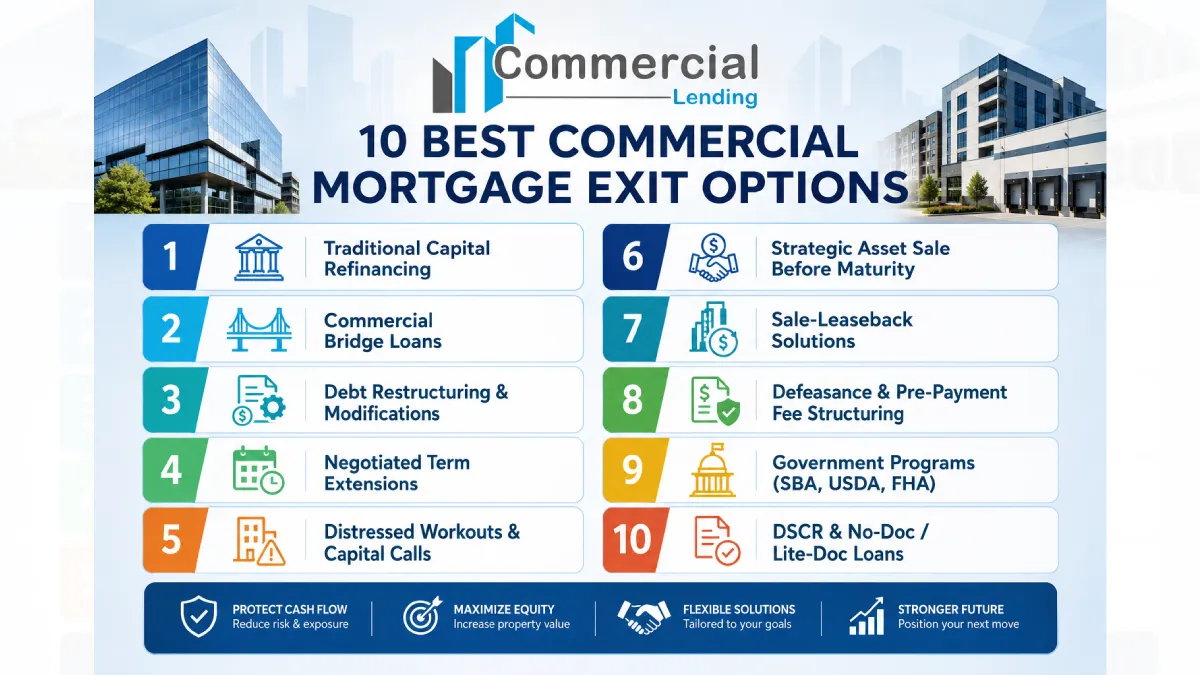
Option 1: Traditional Capital Refinancing
Replacing an expiring loan with a new permanent loan is a proven strategy for stabilized properties. Permanent financing can provide predictable, fixed-rate terms for 5, 7, or 10 years. This option works well for properties with steady rental income, high occupancy, and controlled expenses.
When refinancing commercial mortgage balloon payment debt, you replace the existing loan with new financing and establish a new amortization schedule. Reviewing the pros and cons of refinancing commercial property loan products can help you choose the financing option that best fits your property and financial goals.
- Pros: Stable interest rates, longer repayment terms, lower default risk, and potential cash-out from property appreciation.
- Cons: Closing costs, new appraisal requirements, stricter income qualifications, and potentially higher interest rates than your current loan.
Agency lenders such as Fannie Mae and Freddie Mac provide competitive fixed-rate financing for multifamily properties. Life insurance companies typically offer favorable financing terms for low-risk commercial properties.
Option 2: Commercial Bridge Loans
Properties with high vacancies, upcoming lease expirations, or major repair needs may not qualify for traditional bank refinancing. A bridge loan provides short-term financing for 12 to 36 months, giving you capital to cover debt service while you renovate the property, increase rents, or secure new commercial tenants.
Planning commercial bridge loan exit strategies requires a clear plan for returning the property to stable financial performance. Investors use bridge financing for fix-and-flip projects and commercial property conversions. Once the property reaches strong occupancy and stable rental cash flow, the bridge loan can be repaid through long-term financing or an asset sale. Bridge loans typically carry higher interest rates and fees, but they can provide faster access to capital when timing matters.
Option 3: Debt Restructuring and Modifications
When interest rates rise and banks tighten their lending standards, negotiating new terms with your existing lender may be a practical solution. Exploring debt restructuring commercial mortgage options can help you adjust your loan terms without taking on the high closing costs of a new mortgage.
Lenders may structure loan modifications in several ways:
- Interest Rate Adjustments: Your lender may reduce your interest rate or convert a floating-rate loan to a fixed-rate loan.
- A/B Note Split: Your lender may divide the loan into a primary A-Note and a deferred B-Note, making the immediate debt burden more manageable.
- Principal Payment Deferral: Your lender may temporarily defer principal payments to preserve monthly operating cash flow.
Banks may be more willing to consider restructuring when you provide complete and accurate financial records. You need to demonstrate that the property’s financial challenges are driven by broader market conditions rather than ineffective property management.
Option 4: Negotiated Loan Term Extensions
If credit markets tighten or tenant lease-up takes longer than expected, requesting an extension can provide valuable additional time. Lenders may prefer short-term extensions over the costs and risks associated with foreclosure.
Choosing extending commercial mortgage terms options typically requires meeting several lender conditions:
- Signing a formal extension agreement and paying a modest modification fee.
- Paying down a portion of the loan balance to reduce the lender’s overall risk.
- Purchasing an interest rate cap to protect the property from future rate increases.
Extensions provide additional time for local rental demand to recover or interest rates to stabilize.
Option 5: Distressed Workouts and Equity Capital Calls
Properties with high vacancy rates, variable interest rates, or declining values may require distressed commercial mortgage exit solutions. When your outstanding debt exceeds the property’s value, traditional refinancing may not be sufficient.
During a workout, property owners may raise additional capital from equity partners or preferred equity investors. Preferred equity sits between the senior bank loan and common equity position. It can fill funding gaps and help the property meet lender debt yield requirements. This additional capital may help prevent foreclosure, preserve the owner’s equity position, and stabilize the asset.
Option 6: Strategic Asset Sale Prior to Maturity
Selling commercial property before mortgage matures allows you to access your accumulated property equity and fully repay the outstanding debt. In a high-interest-rate environment, selling an asset may generate more net cash than refinancing at elevated borrowing costs.
A well-planned sale eliminates the risk of an approaching loan maturity. You may no longer need to contribute additional cash to cover a financing shortfall. When calculating your net sale proceeds, account for legal fees, broker commissions, property taxes, and any loan prepayment penalties.
Option 7: Sale-Leasebacks and Capital Solutions
If you want to access equity from your commercial real estate without disrupting business operations, consider alternatives to selling commercial property with mortgage restrictions. A sale-leaseback arrangement allows you to sell the property to an institutional buyer while retaining operational control as a long-term tenant.
This strategy converts real estate equity into working capital. You can use the proceeds to repay maturing debt and fund core business growth. Companies commonly use sale-leaseback transactions for industrial facilities, corporate offices, medical centers, and retail properties.
Option 8: Defeasance and Pre-Payment Penalty Structuring
Paying off a commercial mortgage early can result in significant prepayment penalties. Wall Street CMBS loans often include strict defeasance or yield maintenance provisions that protect bond investor returns.
Learn how to avoid commercial mortgage pre-payment penalties by considering these payoff strategies:
- Defeasance Bond Swaps: Replace the real estate collateral with a portfolio of U.S. Treasury securities structured to cover the remaining loan payments.
- Assumable Loan Transfers: Transfer the existing loan to a qualified property buyer, allowing the buyer to retain the existing financing terms and potentially avoid certain prepayment costs.
- Step-Down Timing: Time the loan payoff around scheduled reductions in prepayment fees, such as a 3%-2%-1% structure, or use a fee-free open period near maturity.
Choosing the right strategy can significantly reduce prepayment costs during a property sale or loan payoff.
Penalty Type | How Lenders Calculate It | Financial Impact on Cash | Best Way to Mitigate Costs |
Yield Maintenance | Compares remaining interest payments to current U.S. Treasury yields. | Costs more when market rates drop below your original loan rate. | Transfer loan to buyer or wait for open payoff windows. |
Defeasance | Swaps real estate collateral for U.S. Treasury bonds. | Requires extra legal, accounting, and broker execution fees. | Use defeasance experts to source low-cost bond baskets. |
Step-Down Schedule | Fixed fee percentage drops each year (e.g., 5%, 4%, 3%, 2%, 1%). | Gives clear, predictable payoff fee numbers from day one. | Schedule property sales during low-percentage fee years. |
Open Payoff Window | Zero penalty fees applied right before your maturity date. | Completely removes early payoff penalty costs. | Time your closing date inside the open window period. |
Option 9: Government-Backed Refinancing Programs
Government lending programs can provide long-term financing for commercial property owners. These programs may feature higher loan limits, longer repayment periods, and competitive interest rates.
Top government-backed options include:
- SBA 504 and 7(a) Loans: Suitable for owner-occupied business properties, with financing of up to 90 percent in qualifying cases and repayment terms that can extend up to 25 years.
- USDA Business & Industry (B&I) Loans: Provide financing for commercial properties, hotels, and industrial assets in eligible rural areas.
- FHA / HUD Commercial Financing: Can provide long-term financing for multifamily properties, senior living facilities, and healthcare properties, with certain programs offering terms of up to 35 years.
Government-backed financing can reduce exposure to balloon-payment risk when the loan is fully amortizing over its term.
Option 10: DSCR and No-Doc / Lite-Doc Loans
When personal tax returns or complex corporate documentation slows down bank underwriting, debt service coverage ratio (DSCR) loans can provide another financing option. DSCR lenders focus on the property’s rental cash flow rather than relying primarily on the borrower’s personal income documentation.
These programs can help fix-and-rent investors, residential portfolio buyers, and commercial property owners secure financing based on the property’s net income, value, and available cash reserves. No-doc and lite-doc programs may offer a simpler documentation process than traditional bank loans. Using these financing options can support proven strategies for exiting commercial real estate loans with greater flexibility.
What Is the Right Strategic Path for Your Property?
Choosing the right strategy depends on your property condition, cash flow, available capital, and timeline. Review the comparison table below to see which option best aligns with your situation:
Exit Strategy | Building Status Needed | Typical LTV Limit | Average Time to Close | Pre-Payment Fee Risk | Best Asset Types |
Traditional Refinance | Fully Occupied | 60% – 75% | 45 – 90 Days | High (Yield Maintenance) | Apartments, Industrial, Storage |
Bridge Loan | Renovating / Vacant | 65% – 80% | 14 – 30 Days | Low (Short Terms) | Mixed-Use, Retail, Hotels |
Debt Restructuring | Cash Flow Strained | Custom Terms | 60 – 120 Days | Negotiated / Waived | Office, Distressed Sites |
Term Extension | Nearly Stable | Existing LTV | 30 – 60 Days | Low (Extension Fees) | All Commercial Assets |
Distressed Workout | Over-Leveraged | 70% – 85% Total | 30 – 75 Days | Varies | Office, Transitional Retail |
Strategic Property Sale | Market Ready | Market Value | 60 – 120 Days | Paid at Closing | Industrial, Apartments, Land |
Sale-Leaseback | Owner-Occupied | Up to 100% | 60 – 90 Days | None (Debt Repaid) | Industrial, Medical, Corporate |
Defeasance Swap | CMBS Debt Asset | N/A (Payoff) | 30 – 45 Days | High (Bond Costs) | CMBS Securitized Debt |
Government Loans | Business / Apartment | 75% – 90% | 90 – 180 Days | Declining Step-Down | Rural Sites, Senior Care |
DSCR / Lite-Doc | Rent-Generating | 65% – 75% | 21 – 45 Days | Moderate (1-3 Year Fee) | Rentals, Mixed-Use, Commercial |
Use this step-by-step timeline to execute your plan:
- 12 to 9 Months Before Maturity: Calculate your annual net rental income, review local market cap rates, and estimate any potential loan payoff shortfall.
- 8 to 6 Months Before Maturity: Request an official payoff statement from your lender, calculate prepayment penalties, and verify current property occupancy.
- 5 to 4 Months Before Maturity: Work with correspondent lenders or financing advisors to compare traditional, bridge, DSCR, and government-backed loan options.
- 3 to 2 Months Before Maturity: Select the best financing option, submit formal applications, order third-party property appraisals, and obtain underwriting approval.
- 1 Month Before Maturity: Review final loan documents, arrange required payoff funds, complete any loan modification documents, or close the property sale before the maturity deadline.
Which Path Will You Choose for Your Commercial Property?
The large volume of commercial real estate debt reaching maturity means property owners need to plan early. With $875 billion in commercial loans coming due, waiting for interest rates to fall may create additional financing risk.
By starting early, you can evaluate the best commercial mortgage exit options for your specific situation. Whether you need a traditional refinance, a bridge loan, government-backed financing, or a sale-leaseback, early planning gives you more time to compare options and prepare for maturity.
Commercial Lending USA can help you evaluate these options. With 30 years of underwriting experience and access to 75 loan options, our team can help structure an exit strategy based on your property and financial position. Contact us to review your maturing mortgage and discuss your available financing options.
FAQs
Can cash-out commercial refinances trigger income taxes?
No, proceeds from a commercial cash-out refinance are generally not treated as taxable income because they represent borrowed funds rather than earned income or capital gains. This can allow property owners to access available equity without triggering income tax on the loan proceeds, subject to applicable tax rules and individual circumstances.
Does a non-recourse loan protect personal assets?
Yes, non-recourse commercial loans generally limit a lender’s ability to pursue a borrower’s personal assets after a maturity default. However, certain “bad-boy” carve-outs may allow lenders to enforce personal guarantees in cases involving fraud, misappropriation of property income, or voluntary bankruptcy.
Can cross-collateralization complicate commercial mortgage exits?
Yes, cross-collateralizing multiple commercial properties places them under a single loan lien. This structure typically requires lender approval and a predetermined release price before you can sell or refinance an individual property without paying off the entire loan.
Do environmental hazards block commercial loan refinancing?
Yes, environmental contamination identified during a Phase I assessment can delay or prevent mortgage approval. In such cases, property owners may need to obtain specialized environmental remediation financing or fund a lender-controlled escrow account before completing a refinance or sale.
Can short ground leases ruin refinancing options?
Yes, commercial lenders may decline to refinance a leasehold mortgage when the remaining ground lease term is too short relative to the proposed loan term. Owners may need to secure a lease extension before obtaining replacement financing.
0 Comments
Leave A Comment