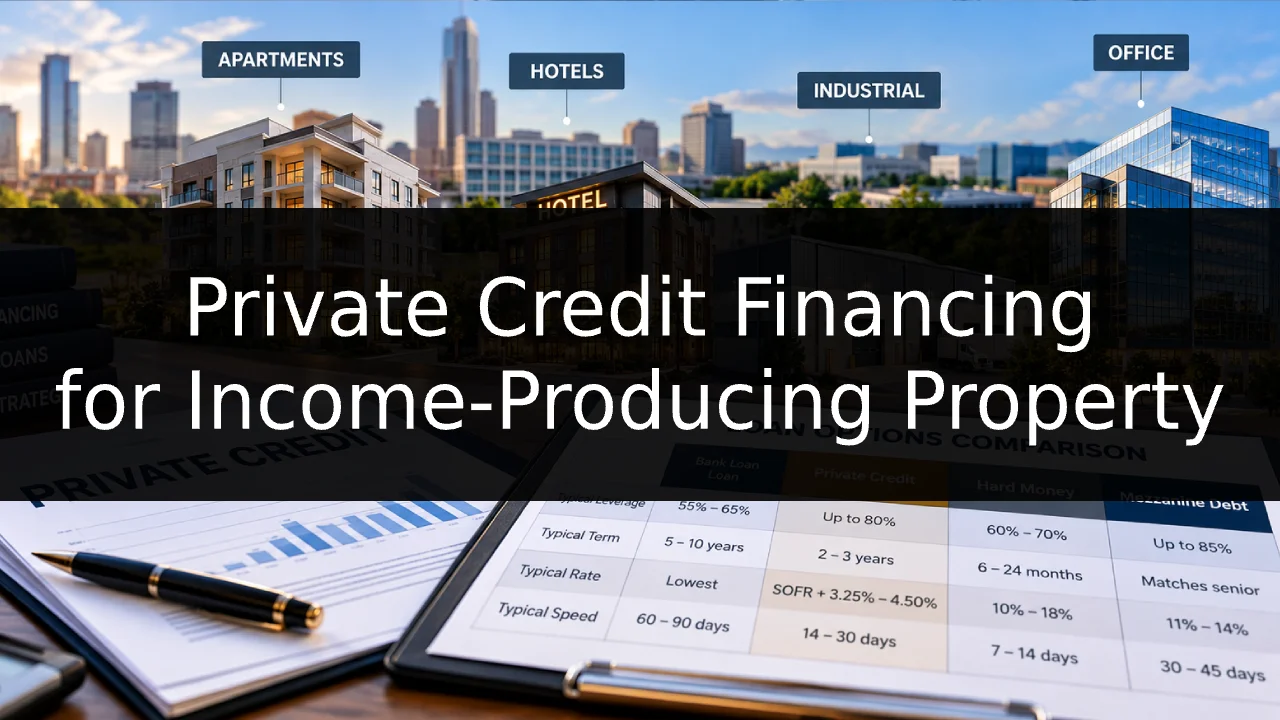
Private Credit Financing for Income-Producing Property: 2026 Guide
Private credit is a loan from a non-bank fund or investor. A rental or work building backs it. Many deals close in 14 to 30 days. It costs more than most bank loans. Most owners use it as a bridge to cheaper debt.
How Big Is the 2026 Loan Maturity Wall?
The MBA loan maturity survey says $875 billion in loans on business buildings come due in 2026. That is 17% of all such loans. It is 9% less than the $957 billion due in 2025. Another $652 billion is due in 2027.
You may see bigger totals online. Some add loans that lenders let slide. Others count one lender type. That is why the totals range from $875 billion to $1.8 trillion. We use MBA data. It covers all lenders.
Some building types face more strain. See MBA loan data by building type, 30% of hotel loans come due in 2026. So do 23% of loans on industrial sites. Office is 17%. Health care is 15%. Apartments are 13%. Loans backed by federal housing agencies make up just 4%.
For two years, many lenders chose to extend loans. MBA's top economist says that habit is fading. So more owners must pay off, refinance, or sell. MBA also expects $805.5 billion in new loans in 2026. That is up from $633.7 billion in 2025.
Are Banks Really Backing Away?
Less than before. In the Fed's July 2026 bank survey, banks said they eased rules for these loans. Demand was flat. In March 2026, regulators also put forward new bank capital rules that would ease limits. Old posts that say Basel rules will choke bank loans are out of date.
So why use private credit? Fit and speed. Banks like full, stable buildings and low debt. Most want a personal pledge. Approval often takes 60 to 90 days. A half-empty building may not fit. Nor may one that needs repair.
A private fund can shape terms for one deal. After 2008, regulators told banks to take less risk. A Harvard Law School scholar says big funds stepped in. Borrowers pay a bit more. They get speed. The Fed adds that terms are set one deal at a time.
How Big Is Private Credit?
The size depends on who counts. One global watchdog says there is no shared definition. Guesses run from $2 trillion to over $3 trillion. Real estate is one slice. Many funds now lend on buildings. So you can shop for offers.
Private Credit vs Bank, Hard Money, and Mezzanine Debt
Bank loan | Private credit | Hard money | Mezzanine or preferred equity | |
Money comes from | Deposits | Funds and investors | Individuals | Equity funds |
Lien position | First | First | First | Behind the first loan |
Typical leverage | 55% to 65% of value | Up to 80% of cost | 60% to 70% of value | Up to 85% of total capital |
Typical term | 5 to 10 years | 2 to 3 years | 6 to 24 months | Matches senior loan |
Typical price | Often lowest | SOFR plus 3.25% to 4.50% | 10% to 18% | 11% to 14% |
Typical speed | 60 to 90 days | 14 to 30 days | 7 to 14 days | 30 to 45 days |
Recourse | Often full | Often none, with carve-outs | Full or partial | Often none, with carve-outs |
These ranges are typical. Each deal differs.
Agency loans deserve a look too. Fannie Mae apartment loans go up to 80% of value. They need a 1.25x DSCR. The site must be 90% full for 90 days first. Most big agency loans need no personal guarantee. Many private loans do not either.
Hard money looks at resale value. It charges 2 to 4 points up front. Private credit looks at rent income. It gives you 24 to 36 months to do your plan. Equity firms want 12% to 18% returns. They may take a share of your firm. Private credit lenders take the first loan. They leave your stake alone.
What Will It Cost Today?
SOFR is the base rate. SOFR was near 3.9% in late September 2026. Add 3.25% to 4.50%. Your rate is near 7.15% to 8.40%. Fees are extra. The rate floats. So your cost moves.
Here is a simple case. Your building earns $1,000,000 in net income. This is called NOI. You ask for a $10,000,000 loan. The rate is 7.65%, with interest only. Yearly interest is $765,000.
- DSCR: $1,000,000 divided by $765,000 is 1.31x.
- Debt yield: $1,000,000 divided by $10,000,000 is 10%.
Now SOFR rises one point. The rate is 8.65%. Interest is $865,000. Your DSCR falls to 1.16x. That is why lenders ask for reserves and rate caps.
The DSCR is NOI over yearly loan payments. Debt yield is NOI over the loan size. It ignores the rate. Banks often want 1.25x or more. Private lenders may take 1.15x if cash reserves fill the gap. Many want a debt yield of 8% to 10%.
Two more terms matter. LTV is the loan next to the value. LTC is the loan next to your total cost, with repairs. Private lenders may lend up to 80% of cost for upgrades.
How Stacking Debt Cuts Your Cash Need
Layer | Typical size | Typical price | Key features |
Senior bridge loan | 65% to 70% of cost | SOFR plus 3.25% to 3.50% | First lien, interest only |
Unitranche loan | 70% to 80% of cost | SOFR plus 4.00% to 4.75% | One loan, one set of papers |
Mezzanine debt | 10% to 15% | 11% to 13% fixed | Second-place pledge |
Preferred equity | 10% to 15% | 12% to 14% return | Control if you default |
Your cash | 15% to 20% | Target 15% to 18% | You keep the upside |
You might use 65% senior debt, 15% mezzanine debt, and 20% cash. Each layer adds cost. Test your blended rate before you sign.
Which Property Types Fit?
Property type | Share of loans due in 2026 | Common takeout loan |
Multifamily | 13% | Fannie Mae or Freddie Mac |
Industrial | 23% | Life company or CMBS loan |
Health care | 15% | HUD 232/223(f) or bank |
Hotel | 30% | Bank, CMBS, or private term debt |
Office | 17% | Smaller loan plus new equity |
Apartments. Lenders like room to lift rents. Fix units and lift rents. Then move to an agency loan. That exit needs 90% full for 90 days.
Senior living. Banks often shy away from staff costs and license rules. A private bridge can fund a fix first. Then you can seek a HUD 232/223(f) loan. HUD built an Express Lane. It cuts review from five months to two weeks for low-risk deals.
Warehouses and hotels. Web sales lift demand for warehouses. New hotel supply grows slowly, near 1.3% a year by one forecast. Owners use bridge cash for upgrades. Then they refinance.
Risks to Weigh Before You Sign
- Floating rates. Payments rise when SOFR rises. Ask for a cap.
- Short terms. Two to three years pass fast. Plan your exit at the start.
- Reserves. Lenders often hold cash at closing. That ties up funds.
- Fees. Compare all fees. Do not judge by rate alone.
- Recourse. Non-recourse debt still has carve-outs. Fraud can trigger a guarantee.
- Lender strength. The IMF found that over 40% of firms with private loans had negative cash flow at the end of 2024. That is firm lending, not building loans. Still, check that your lender can fund on time. Check that it can bend.
Extend, Refinance, or Sell?
Start with your own lender. Ask for more time. Many will trade it for a paydown, more reserves, or a higher rate. If they say no, get private quotes. If the math fails at every price, a sale may protect your equity.
Use this timeline:
- 18 to 12 months out: Check your due date and any extension rights. Gather your rent roll, income report, and leases.
- 9 months out: Talk to your lender. Ask two or three others for quotes.
- 6 months out: Pick your exit. For an agency loan, check occupancy and DSCR rules.
- 90 days out: Sign a term sheet. Order the reports.
- 30 days out: Clear closing items and fund reserves.
How to Find and Vet Private Lenders
You have four routes. You can call funds directly. Big owners often do this to save fees. You can use a site that sends your deal to many funds. You can work with a broker. Or you can hire an advisor to shape your deal.
Our guide on how to find a private lender covers each route. Use our loan checklist to prep your file.
Vet every lender. Ask for proof of funds. Ask for a term sheet in writing. It should list all fees. Beware of big fees paid before a term sheet. Read the drawbacks of private money so you know the trade-offs. Also see our bank vs private guide and our list of other lenders.
How Commercial Lending USA Helps
We bring 30 years of deal skill. We act as a direct lender. We are also a super broker. Through our network of 200+ lenders and investors, we match each deal to the right capital.
Browse our loan products. They include bridge, hard money, DSCR, SBA, FHA, and construction loans. Our commercial loan page covers loans up to $100 million. Weak credit is not always a wall. See our options for weaker credit.
Ready? Start a loan inquiry or contact our team at 855-365-9200. Visit our home page or resources to learn more.
Brokers can join our referral plan. Read our referral guide first. Investors can see our lender page.
FAQs
Can it cover cost overruns?
Often, yes. A lender may add a second loan or grow the bridge. It will check the budget, the plan, and your equity.
Does non-recourse debt protect my assets?
Mostly. The lender looks to the building if you default. Carve-outs apply for fraud and bankruptcy. Some private loans still need a guarantee.
Can I get more time?
Many bridge loans offer one or two extra terms. You pay a fee. You must meet income tests.
Do lenders hold cash reserves?
Often, yes. Lenders may hold cash for interest or repairs at closing. It covers payments while income grows.
Can I use private credit to buy a distressed property?
Yes. Many private lenders fund troubled buildings. They can close fast.
0 Comments
Leave A Comment